
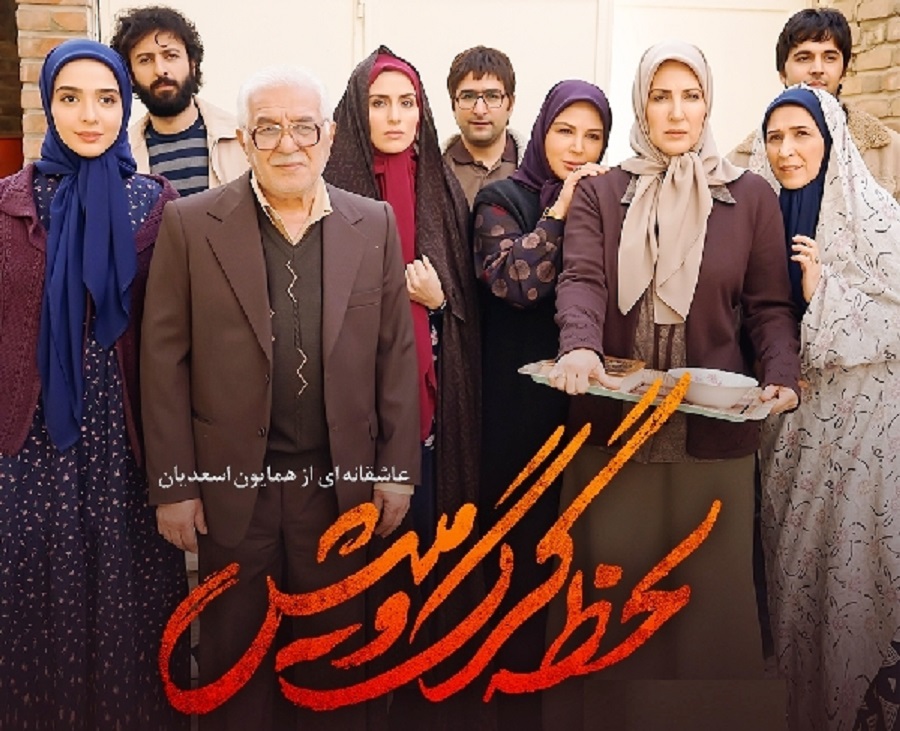
The Twilight series makes teenagers Twilight.
Since this series is currently being broadcast on the 3Sima network, I am currently providing an enlightening review of it to serve as a wake-up call and warning to the audience, especially teenagers, so that they will not be influenced by some of its undocumented historical scenes and moral behavior. God willing, during the broadcast. I will write a detailed, expert, and technical review of the episodes of this series or after it has aired, and I will present it to the esteemed reader for their benefit. It is worth noting that this review is devoted to three episodes of the series.
Twilight series is two-dimensional:
1- The first dimension is commendable and reflects the eight years of the Sacred Defense, albeit faintly, but to some extent well, although some of its scenes do not correspond to the reality of this historical event in our country. 2- The second dimension is hateful and shocking, because it portrays unrealistic social relations. It reflects the society of our country in the 1960s. There are many of these cases, but for now I will briefly mention some as examples: – The brutality, harshness, lack of culture, and foul language of the war-torn family, which has been negatively portrayed in the series, is in stark contrast to the reality of the kind people of the region. The south of our country is not in harmony… – The Ironi family’s violation of social and moral boundaries is not in harmony with the reality of our society. Therefore, what is presented in this television series will lead to the formation of a wrong behavioral culture among young girls and boys. – Love in girls’ relationships And boys, if it is in a healthy traditional-religious way with family involvement, this love is sacred. But in this series, it has reflected vulgar love and perhaps the writer wants to culturalize this social behavior. (I hope not) – Children and adolescents of the eighties , and the youth of our country, by watching the Twilight series, will behave brutally and immorally in the future. That is, healthy social relationships will be lost, which in turn is the ultimate goal of soft war, although it is unintentional and not the intention of the series’ writers. – The writers of the scenario of this series, unfortunately, have not written in line with the valuable culture of our country’s society, and the content thinking of the series “Bachah Mohandes” lies in it, which was broadcast on the network by depicting the false love and relationship between two teenage children. Recently, the wave of perverted social relations And the anti-culture content of our country’s value society is seen in the Iranian Broadcasting Corporation’s television programs, as if the scripts and even the plots of studio programs, before being recorded, are not scrutinized, and perhaps to the extent of the carelessness and thoughtlessness of the network group officials, but they reach the airwaves. My view is not all negative, this series also has positive factors. The beautiful camera track at the grave of the martyrs of the imposed war and the LS and extreme long shots respectively of the view of the grave and the multitude of martyrs sleeping in the ground, some of whom are unknown martyrs, and Khak Behesht Zahra succeeds in embracing the pure bodies of nameless and unmarked youth. By depicting the spiritual atmosphere of this sequence, accompanied by beautiful music, it instills in the audience the inner feeling of a captive who has just returned from captivity. Narrating the important historical event of the return of the freed people to Homeland is an important issue. I remember that when our prisoners returned from Iraq to our country, there was a passionate welcome from the people. But Hamed’s return is seen in absolute silence and without the presence and joy of the people in the series. Meanwhile, the Iraqi Baathists, who liberated individually They did not, but they were releasing our prisoners in groups. Also, Hamed’s name is included in the Red Cross list and is not among the secret prisoners in custody. However, the reflection of this event in the series’ scenario is so distorted and different from reality that even Hamed’s family is not happy about his freedom and They were unaware of their son’s return!! I’m not just pointing my finger at the writer of the series. Maybe this historical event was well covered in the scenario, but the director, who is the producer of the series, deleted this important sequence. In any case, it was Or the lack of chronicling the return of the freedmen in the series’ scenario is not due to the director’s negligence in the camera, but rather, he used the best visual technique, and with delicate, varied, and memorable decoupage, to record the moment of the return of the prisoners. In this regard, the respected director’s attention to the film “The Smell of Yousef’s Shirt” by Ebrahim Hatamikia, produced in 1995, with the strong playing of Ali Nasirian, accompanied by the beautiful music of Majid Entezami, which has remained among the musical masterpieces of the 8 years of sacred defense.
 As a critic, I would like to ask Mr. Homayoun Asaadian this question: What is the reason for not addressing the historical event of the return of the freedmen to our country in the series “The Twilight Moment”? It is necessary to explain the need for the presence of thousands of people in the role of freedmen and hundreds of families and their reception. It is not the people. Rather, it is possible to reconstruct the event visually using the chroma key technique or broadcast it on television with Hamed among the crowd. However, so far, not all of the chroma key images in this series have been ideal, and its amateurism is not worthy of the technique and art of broadcasting. The ironed clothes and polished shoes of Hamed, who has just returned from Iraq, are not real. Yes, when the Iraqi prisoners returned, they wore new suits and shoes, and the Prisoners of War Administration Commission gave them souvenirs such as a handbag of pistachios and Isfahan gaz. But Our freedmen returned to the country in military uniforms, which were different from Hamed’s. The preservation of records of Hamed’s winter clothing and other characters on the Vahed Line bus and on the streets is commendable. When Hamed returned, it was the cold season of December. Exactly at the same time as The date is included in the funeral announcement posted on the wall of Alireza Rajabi’s shop. This subtlety in the program is mentioned because of the intelligent work of the stage secretary and the directing team in maintaining records. Background of Homayoun Asadian, the respected director of this series Unprofessional chroma keying of vehicle shots should not be tolerated. For example, the chroma keying of the background images of Hamed and the passengers on the single-lane bus is very poorly done and its unreality is obvious, whereas in this scene, the director is trying to exploit The chroma key technique (realism) merges virtual images with real images in such a way that the audience does not feel the composition of both virtual and real images and believes and accepts it, for example: in the virtual scenes of vehicles when Hamed returns from Behesht Zahra, The scales are not observed and the speed of the chroma key images is not consistent. The light on the passengers’ faces is constant and the light balance should be seen as the car moves. In addition, sometimes by spraying white and orange light effects, an autumn atmosphere is created, and since all The chroma key images are deliberately out of focus, a soft and beautiful diffused light could shine on the faces and this is how Hamed’s spiritual feeling on his return from Behesht Zahra is conveyed to the viewer. Unfortunately, this soft and attractive professional lighting atmosphere is lost in key scenes. Zahra’s paradise, and the vehicle, were not seen. Hamed’s longing for his return from captivity on the first night of dinner at his home, with only his mother, sister, and son-in-law in the company, is very cold and soulless. The joy and delight of the sister and mother, after years of waiting, should be loud in this scene. Yasman’s worry about marriage in The comparison with Hamed’s release from captivity and his return to his mother’s embrace and the long-awaited end of his sister’s life is not a place for Arabs and should be understated, but in practice, the scenario pays more attention to the informal, religious and socially unconventional romantic relationship between these two young men. Hamed’s Life After captivity, in the scenario, he would discuss his romantic relationship. It was a relationship that contradicted Hamed’s religious appearance, virtues, and inner self. Therefore, the sum of these two contradictions, Hamed’s justified appearance and inner self, contradicted the unjustified romantic relationship of this type of religious youth, and this is the rule. A phenomenon in philosophy, “the sum of opposites is impossible.” The current fathers and mothers (the audience of the series) who were young in the sixties and seventies, got married and now have children, their children, seeing the open relationships of girls and boys of the sixties (the parental covenant) on television, Bad behavior, which was not common in the society of those two decades, has a negative impact on children, and any advice and counsel from parents remains ineffective and is questioned. In this way, the moral culture of children and adolescents who watch this series, like Jasmine’s son, is fascinated by dancing. Michael Jackson becomes his 16-year-old daughter, chatting with boys and making secret promises. The result is, “The Twilight Series Twilightizes the behavior and relationships of our country’s boys and girls…”