
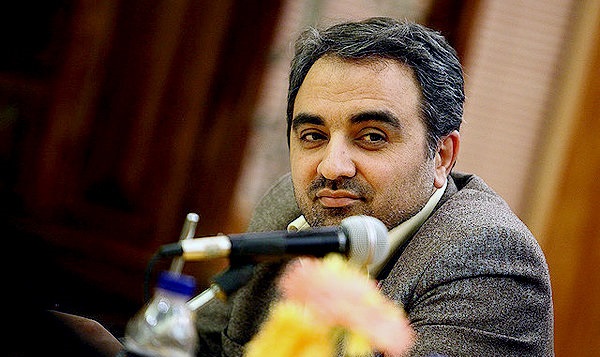
Ali Zarean, born 1972/Shahrza /Master’s degree in Literature
Producer, designer and writer of children and young people programs in IRIB networks and head of children and young people groups of Networks 2 and 5 and responsible for planning and programming of the children and young people group of Network 1

What is a successful program?
Like any other successful work, a successful program is one that achieves its designed goals. And if in a work we have decided to reach a small topic and have reached it, then that program is successful. And for a program to be successful, its goal planning must be realistic, not imaginary.
How can a program maker know if they have reached their goal?
The first and most important thing is that the program has been able to attract the audience’s attention and perspective, the second thing is that it has been able to meet the goals of the commissioner, which is television, and the third is that it has performed a logical programming behavior with limited resources and managed resources properly.

What are the commissioner’s goals?
Look, for example, we want to produce a program for 9 to 10 AM and our goal is to teach life skills to a toddler and involve parents in watching along with the toddler. When something comes under the name of life skills, it becomes measurable. Well, life skills are the same 170 topics that we need to address. If we addressed them and the audience received the topic, this is a successful program. Even if it doesn’t make a strange noise or fuss. Programs that create hype or extreme popularity cannot be our benchmark for judging other programs. It is like a calm and educational program that is completely logical cannot be compared with the Fitileh program. Rather, we must have properly defined the scope of our definitions.

In your opinion, in program making for children, can moral concepts be conveyed to children? If yes, what rules and criteria do you suggest for doing so?
80 percent of a person’s personality traits are completed by the age of eight, and the remaining 20 percent evolves from age 8 until death. So not only is this period a time for education and presenting concepts, but it is perhaps the greatest base for transferring concepts. In groups that have an “audience-centric” classification, the diversity of formats is on par with the diversity of formats in a television network. And this diversity ranges from documentaries to game shows and from variety shows to animation. This vast diversity of formats and the strong impact on the audience make us realize that the best territory for producing programs on television is toddlerhood and childhood. A child receives 20 times more from television than an adult and has no denial resistance against television, meaning they do not have the natural dialogues that adults have, such as “nah, that’s a lie.” This means they are a passive and receptive person. But passive is not a good word.
What suggestions do you have?
We do not make suggestions because it already exists. Program-making indicators are in two parts: one part is structural and one part is content-based. These structures and contents are based on standards. For example, in the world, subject classification for toddlers is defined and separated according to psychological findings such as Piaget’s, and whatever new work we want to do must be based on that existing structure.
Does the age of the audience (toddler, child, teenager) and their gender have an effect on choosing a particular format for them to watch? If yes, which format will they like and what is the reason for this choice in your opinion?
Yes, audiences and gender are influential in choosing a format. Some formats are designed to make content very accessible. On the other hand, game-centrism, imagination, and storytelling are principles of conveying concepts to toddlers. If a format has more affinity with these concepts, logically it has a greater impact; a clear example of this is animation, whose depth of impact is far greater for toddler and child audiences than other formats. Contrary to what many people think, teenage audiences also enjoy direct speech and like talk-show programs.

Can it be said that some formats have a closer affinity with the religious approach and their potential for containing moral content is greater? If yes, which formats? With what characteristics?
Without determining the content, we cannot talk about structure. For example, since we do not know whether we want to pour water or stones into this container, deciding whether the container is made of glass, wood, paper, or something else is not specified. With this idiom, I want to tell you that the way itself tells you how to walk. I believe the content determines which format suits its stature.
Is there a special relationship between format and content?
And there is a relationship between format and content. Polls show that taste at the gender intersection is not comparable to taste at the age intersection. Meaning that the taste of a 9-year-old girl is closer to a 16-year-old girl than to a 9-year-old boy. And this is a completely personal finding that reviewing polls from recent years has shown me. Of course, this separation has conflicts with Piaget’s levels, but it is not so deep that it cannot be resolved. And this is a specific and completely personal finding obtained from various polls. If a program is supposed to be produced for a specific gender group, special interests are inherently separable from age.

Name a few important and influential features in one of the children’s program-making formats that you think helps in attracting the audience to this format, and if possible explain why you think this feature helps?
I will give you a few examples along with the reasons for those programs’ success:
One is the program “Bachchehaye Dirouz” (Children of Yesterday) which was not made for children at all and was produced for children of the past, and the reason for its success is nostalgia. Meaning it takes the audience’s mind back to their childhood. Philosophically, this program is adjacent to childhood and makes one’s current state of childhood feel good. The program “Nimrokh” had a simple format, but its content was rich and well-organized. And the audience turned to it to receive content. And this program was content-centric and the format was in the background, and the audience chose it because of its outspokenness. The program “Amoo Pourang” is another such program, the reason for its success being its modernity, up-to-dateness, and musicality.

How do you evaluate the budget situation for producing children and young people programs?
Child program cost indicators in Iran across all formats are not comparable to any figure anywhere in the world. A blatant poverty prevails here, with no attention paid to the target population and its impact. We currently have about 15 million toddler, child, and teenage audiences, but our financial commitment bears no relation to this population. All the discussions we have about structure and content, without investment, are just a collection of good writings and have no effect anywhere. For example, in the presentation of live-action shows, no investment has been made for children, and many miniature theories have disrupted children’s content. The miniature theory says a child is the same as an adult in smaller dimensions, and this is a disaster. For example, believers in this theory believe that if we tell the story of Prophet Abraham (PBUH) for adults, we should tell the story of Prophet Ishmael (PBUH) for children, or if we tell the story of the Battle of Badr for adults, we should tell children the story of a smaller battle. A child and toddler are inherently different from an adult, and unfortunately, this has no place in policymaking. Currently, 19 institutions are active for children in the country, and not one of these institutions is coordinated with another; they are standing against each other. 19 institutions mean 19 ways of thinking, 19 conducts, and perhaps very often these even conflict with each other.
Do you consider the presentation of moral concepts to be among the factors of attracting children (in children’s programs)?
Moral concepts are not inherently attractive and are part of the musts of life, and humans inherently flee from them. Moral concepts themselves are not attractive, and the way they are presented is what makes them attractive. For example, order inherently has a difficulty, and the toddler audience wants to flee from it, but the perspective we give to children compels them to follow this moral option. But the element of morality itself conflicts with infantile and childish egocentrism. This path must be traversed very calmly and logically so that they accept it.