
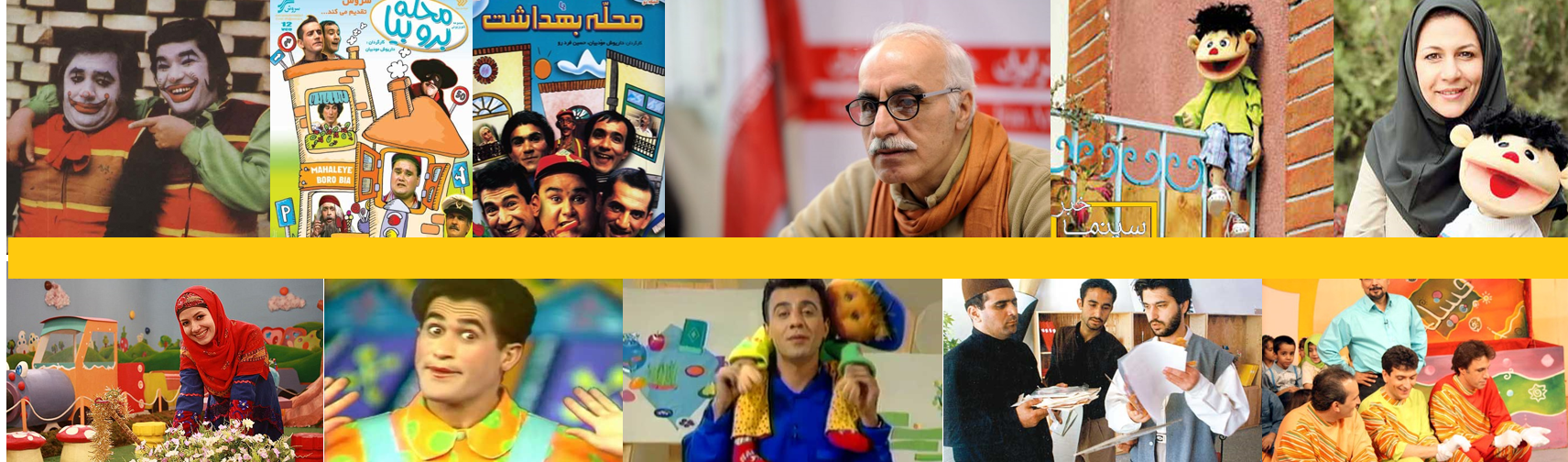
- Book Title : TV Variety Show for Children
- Author : Negin Hosseini
- Publication Year : 2006
- Number of Pages : 182
Description:
“A television variety show is a composite program with a mosaic structure whose segments revolve around a specific axis. This book examines the characteristics of television variety shows, their advantages over other forms of children’s programming, and practical and operational tips for producing television variety shows for various age groups of children.
Considering that, according to research conducted, children have a special interest in variety-style programs, program makers are advised to pay more attention to meeting the recreational and educational needs of children in the format of a television variety show by utilizing the points mentioned in this study.”
This book, which is an abstract of the author’s master’s thesis at the Faculty of IRIB (Islamic Republic of Iran Broadcasting), is written regarding how to produce one of the most attractive forms of television programming – the variety show – for children, and in its own right, it can be considered the first comprehensive Persian source in the field of television variety shows.
This research has examined the role of image perception and visual characteristics in television variety shows and has specifically investigated this subject from the aspect of providing information and educating children. It is noteworthy that this research even examined the role of color and light in educational television variety shows.
According to the author, “Children in different age groups have specific physical, mental, and emotional characteristics and conditions, and accordingly, they have a different understanding of visual systems. To produce programs including television variety shows, especially with an educational approach, one must first understand the psychological characteristics and requirements of the child audience and then present the most appropriate visual methods based on them.”
Familiarity with television variety shows as a programming format, understanding the characteristics of children at different ages and their perception of images, and methods of more effectively and attractively drawing children to the program are the main topics of this book, which are presented alongside examples of successful global variety shows and the specific subtleties of their creators as several case studies.
Of course, it is worth mentioning that the approach of programmers in Iran to producing television variety shows for children, although sometimes in semi-professional forms, has a relatively long history. In the years 1967-1968, efforts were made in the television children’s group to produce programs in the form of composite programs (considering the core and central goal) with a dramatic format that also had educational aspects. Around 1971, through the efforts of Dariush Movadian, a program was produced in the form of a magazine. At that time, this program format became known as Children’s Show or Variety, and in its various segments, songs were also broadcast. Interestingly, in an interactive and participatory action by producers and viewers, singers beloved by children were invited to the program to perform songs. In this program, Dariush Movadian, Mohammad Motee, and Ahoo Kheradmand performed plays for children in the roles of three animals.

In the program Mehrang and Orang, which did not look much like the composite program format, alongside storytelling, the presence of children in the studio and guiding them to participate in the program was also utilized. After the victory of the Islamic Revolution, in 1982, a series called School Bell was produced with the cooperation of Dariush Movadian and the late Behbahani and broadcast in 10 episodes, aiming to educate children to get acquainted with the school environment. Malek Motee, in the role of a school custodian, narrated stories to the kids. The puppet series School of Mice, directed by Marzieh Boroumand, entered this television series as part of the program. Although after broadcasting only 10 episodes, due to a change in the management of the children’s group at the time, the broadcast of this series was also halted.
In the same year, a variety show called Elders – Little Ones produced by Mahnaz Mirjahangiri, written by Bijan Birang and Dariush Movadian, and directed by Movadian was made for children and families, but this 13-episode series never got the chance to be broadcast for certain reasons.
However, the years 1983 and 1984 marked a new beginning for producing television variety shows with an educational approach in Iran. The television variety show Mahaleh-ye Boro Biya was made in 1983, directed by Dariush Movadian and Hossein Fardro, with the aim of teaching traffic laws and commuting rules and identifying urban manners of commuting and traffic. In this program, human actors were placed alongside puppet actors for the first time so that children’s understanding of educational content would be enhanced using an attractive dramatic method. The puppet Kalleh (voiced and puppeteered by Fatemeh Motamed-Arya) and the puppet Hossein Agha were among the puppets of this program. After producing this program in 13 episodes, another variety show which was a continuation of this program, called Mahaleh-ye Behdasht, was made in 14 episodes. The purpose of this variety show was also to teach health issues to children and teenagers.
In the 1990s, the production of educational television variety shows for toddlers, children, and teenagers flourished more. Peik-e Sepid-e Shadi produced by Ms. Mahnaz Azin and Excuse Me, Madam! Excuse Me! directed by Mohsen Taghavi Zanooz (Channel One), Aftab-e Alamtab directed by Amir Samavati (Channel Two), SanJand and the Kids of This Neighborhood and That Neighborhood and various SanJand series directed by Amir Feyzi (Channel Two), Tourang and Pourang directed by Sima Ilkhan and produced by Ms. Lida Abdolmanafian (Channel One), and City of Ice Creams co-directed by Mohsen Taghavi Zanooz and Azadeh Pourmokhtar and produced by Ms. Mahnaz Azin (Channel One) were examples of dozens of television variety shows produced during this period with the aim of teaching various subjects to different age groups of children and teenagers.
However, one of the most active producers of television variety shows or magazine-style programs in IRIB is the Nimrokh Culture House, although its audience is not children, but teenagers aged 14 to 21.
The first Nimrokh program was produced and broadcast in 1996 by the Children and Youth Group of Channel One of television with the aim of presenting cognitive discussions and cultural and educational challenges. This program did not have a name for up to two weeks after broadcast, and finally, through a poll among teenagers and upon the suggestion of the Children and Youth Group, the name “Nimrokh” was chosen for this series. The fresh approach of Nimrokh in its tone of speech and direct expression of issues to the audience was considered a notable creativity in its own right and gradually came to be welcomed and accepted by everyone, even programmers, as a special type of programming. So much so that it created a wave that continues in various ways to this day, and even after nearly a decade, we still witness the production of programs in the special style and even with the special literature of Nimrokh across various channels.
Five seasons of the program Nimrokh (from 1996 to 2001), The Eighth President (June 2001), House No. 47 (Autumn 2002), The Next Person (Winter 2002), Nimrokh Bazaar (Spring 2003), and Kabootar.com (Winter 2003 to Summer 2005) were among the productions of the Nimrokh Culture House. Although it is very regrettable to state that the activities of this successful cultural unit have been suspended for nearly a year, and its future outlook is not very predictable either. Hopefully, we will find this House at its peak once again.
Currently, various television variety shows for children are produced and broadcast on various television channels, among which the richest and most principled ones can perhaps be considered the television variety show Bagh-e Shadouneh directed by Ahmad Darvish Alipour (Channel One), which has also achieved notable success in attracting a massive audience.
In any case, considering the wide and diverse functions and facilities that television variety shows provide to programmers, how wonderful it is for interested designers, writers, directors, and producers of television to increase their knowledge in this field, thereby enabling the maximum utilization of the capabilities of this special genre. For this reason, the publication of the book TV Variety Show for Children can be considered a boon, and studying it is recommended to all production practitioners.
TV Variety Show for Children was authored by Negin Hosseini and published by Ettela’at Publications.


یه دختر بور خوشگل ام ۳ سالمه
با استعدادم
دوست دارم یه جوری تو برنامه تلوزیونی حضور داشته باشم
یا تو فیلم تبلیغاتی بازی کنم
شماره تماس ۰۹۱۹۲۶۱۷۷۸۲