
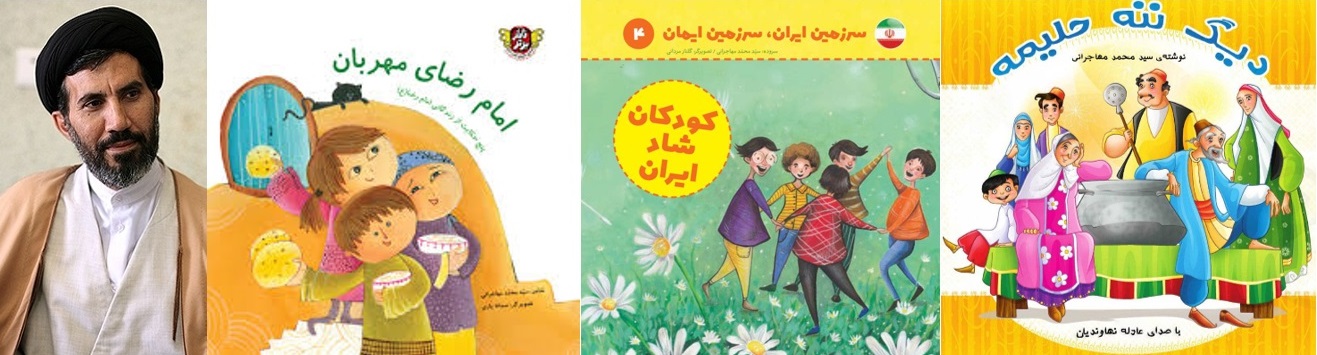
Biography of Hojjat al-Islam wal-Muslimin Seyed Mohammad Mohajerani

Seyed Mohammad Mohajerani was born in 1348 in the city of Mohajeran, Arak. He is a graduate of the Qom Seminary and is considered one of the religious poets for children. Regarding how he started writing poetry, he says: “My first poems—which, to keep nothing from you, were the ghosts of poetry and pseudo-poetry—made their appearance in the year sixty-three. In the year sixty-five, my first children’s poem was born. A poem for children who were waiting at any moment for the arrival of an Iraqi missile. My first children’s book is a collection called ‘Our Dear Prophet’, which depicts the tradition (Seerah) of the Prophet of God in poetic language. Just as Imam Sajjad (peace be upon him) in one of his supplications (the second supplication of Sahifah) calls the Prophet of God Miftah al-Barakah (the key of blessing), this collection opened the door for writing and composing other works and collections, each of which in some way deals with religious concepts.”
Many books with religious themes have been published for children by Seyed Mohammad Mohajerani, some of which are:

Section One: Seerah
A – Seerah of the Holy Prophet of Islam (PBUH):
One – ‘Our Dear Prophet’ collection (14 volumes): The Seerah of the Holy Prophet of Islam for children
Two – ‘Muhammad, a Flower for Everyone’ collection (8 volumes): The Seerah of the Holy Prophet of Islam for toddlers
Three – The Kind Hero (2 volumes): Sports stories of the Holy Prophet of Islam
Four – One Hundred Petal Flower (1 volume): Stories of the Prophet for producers of the IRIB children’s department
B – Seerah of the Ahl al-Bayt (AS):
One – Flower and Butterfly collection (4 vols): The Seerah of Imam Ali and Hazrat Zahra for children
Two – Candle and Butterfly collection (4 vols): The Seerah of Imam Hussain and Hazrat Zainab for children
Three – Fourteen Flower Branches (1 volume): The Seerah of the Fourteen Infallibles for children
Four – Along with Spring (1 volume): Travelogue of Imam Reza for children
Five – Fatimah and Fatimah (1 volume): Similarities between Hazrat Zahra and Hazrat Masoumeh
Six – Five Flower Branches (5 volumes) Hazrat Masoumeh, her father, mother, and two brothers

Section Two: Beliefs
God’s Gifts (10 volumes): Theology for toddlers (God’s blessings)
My Good God (6 volumes): Theology for toddlers (Attributes of God)
How Beautiful Is Our World (5 volumes): Theology for toddlers (God and creation)
Ten Children, Ten Thoughts: Familiarity with Ghadir for children
Signs of Hope: (10 volumes) Laying the groundwork for the discussion of reappearance for toddlers

Section Three: Ethics
First I Say Bismillah: All of a child’s actions begin with Bismillah.
Everyone Says Bismillah: All jobs begin their work with Bismillah.
See and Know (10 volumes): Familiarity with good and bad ethics for toddlers – in the format of textless books
Section Four: Religious Jurisprudence (Ahkam)
Flowers of the Sky Garden (14 volumes): Religious rulings for children (Children’s Resalah)
Green Garden of Prayer: Familiarity with prayer for toddlers
Prayer Can Be Performed Anywhere: Familiarity with places where prayer can be performed
The Most Beautiful Party: Fasting and the blessed month of Ramadan for children
Little Haji: Hajj rulings for children
Butterflies of the Mecca Garden: Umrah rulings for children
Dedicated to Everyone (2 vols): Familiarity of children with endowment (Waqf)
Friendship Stories: Familiarity of children with Enjoining Good and Forbidding Evil
Section Five: Hadith for Children
1. Garden of the Prophet’s Flower (PBUH): Forty hadiths from the Holy Prophet of Islam (PBUH) for children
2. Garden of Imam Ali’s Flower (AS): Forty hadiths from Imam Ali (AS) for children
3. Garden of Ahl al-Bayt’s Flower (AS): Forty hadiths from the Ahl al-Bayt (AS) for children
4. Health Bell: Health hadiths for children
5. A Bouquet from Heaven: Forty hadiths about Hajj and pilgrimage for children
6. Fragrance of the Prophet’s Flower (PBUH): Various forty hadiths for children performing Umrah
7. The Prophet’s Gifts: Forty hadiths from the Holy Prophet of Islam (PBUH) for children
8. Imam Ali’s Gifts (AS): Forty hadiths from Imam Ali (AS) for children

Section Six: Revolution
Gifts of the Revolution: Effects and blessings of the Islamic Revolution
Section Seven: Sacred Defense
Memories of a Chiyab: The beauties of the Sacred Defense

Section Eight: Social
Don’t Forget 125: A look at firefighting from a religious perspective
Water Drops, Precious Gifts: The value of water from a religious perspective
Water Is the Essence of Life: Not wasting water
Environmental Companion: A religious look at the environment
Section Nine: Iranology
Land of Iran, Land of Faith (six volumes): Iranology with a religious perspective
Section Ten: Entertainment
One – Sweet and Sting (4 vols): Familiarity of children with good and bad ethics through play
Two – Kids Riddle (4 vols): Religious riddles for children
Three – 14 Numbers 14 Stars: Familiarity of children with numerical religious concepts
Four – How Beautiful the Alphabet

🌹What is your field of activity now?
My work is divided into two parts: research and writing.
My research is in the field of Islamic foundations and teachings and discovering the beauties of religion and Islamic culture. Beauties that exist in our primary sources, namely the Holy Quran, Nahj al-Balagha, Sahifah Sajjadiyeh, and other hadith books. Of course, my intended purpose is concepts and points that are suitable for the toddler and child age group. And my writing, which is actually the completion of my research work, is converting these pure, delicate, and engaging points of religion into specific literary formats including stories, novelettes, and poetry for dear toddlers and children. I love working for children very much, and as time passes, my love grows, and more than ninety percent of my time and energy is spent in this field. Thank God, I have been engaged in this field for nearly twenty years and have never felt tired.
🌹Considering your scientific level is in the advanced stages of the seminary, why did you decide to work in the children’s field?
If you and I are realistic, my level of knowledge is small, and I do not intend to be modest. When I compare myself with my friends, I clearly realize this truth that my distance from religion experts is vast and I must try to elevate my religious information. However, I thank God for providing the context for me to attend both the seminary and university in the field of philosophy and glean from the harvest of knowledge of the greats.
But as for why I chose to work for children, one answer is that since childhood and even before preschool, I was very fond of poetry and stories, and an old love and some other sweet events that sometimes surprise a person joined hands and kept me in this spectacular arena.
Another answer of mine is that in today’s world where specialization is the rule, just as we have pediatricians and child psychiatrists, in the field of religious teachings as well, whether in the research branch or in the education and writing branch, a group must specialize in working for toddlers and children.

🌹In your opinion, what components should a children’s writer observe and what characteristics should they possess?
In terms of content and theme, they must strive to constantly raise their level of awareness. If working in the field of children’s religious literature, they must try to ensure that their religious information is accurate and documented, so that God forbid, they do not write anything contrary to the will of religion, and try to avoid subjective, superficial, and hasty interpretations in the field of religion.
The second point is that they must know their audience, meaning they must be child-cognizant. Children’s authors sometimes suffer from infantilization and consider children lower than what they are, and the genre and language of their stories smell stale. For example, despite all these changes that have occurred in people’s living standards and many purchases being based on cards, card readers, ATMs, etc., money still appears in their stories just like in the past!
Whereas children completely understand these new economic phenomena.
Or for example, if an author wants to use weaponry in their story, they only use cannons, tanks, machine guns, and rifles, whereas due to the prevalence of war video games, children are familiar with dozens of light, semi-heavy, and heavy weapons that are all new and have new names.
If an author says in their story “That man had a gun in his hand,” the child of today immediately raises the question: What kind of gun? Ordinary sniper? Telescopic? Laser?
Sometimes the author also suffers from aggrandizement and brings themes into their story or poem that are not very clear to children. For example, one children’s poet has a poem about a martyr and addresses the martyr saying you are like a delicate poem and like a long story. What is the point of similarity here? For the author himself, who has been dealing with stories and poetry for years, the point of similarity is clear because a story has a beginning and an end, ups and downs, excitement, a climax, etc. So comparing a martyr to a story is very beautiful and clear, but what does a child understand from this comparison?
And another point is that our writers should try to serve the Persian language and avoid bringing in foreign words. Our children are learning language, and their minds should be full of Persian words. Alas, some people do not pay the necessary attention in choosing Persian words. We have the Academy of Persian Language and Literature, and for many foreign words, attractive Persian equivalents have been coined, such as hamayesh (conference), razmayesh (maneuver), shahravard (derby), rayaneh (computer), etc. Why not make use of these words?
🌹 Your works are usually religious. Why did you choose this subject and how do you utilize it so that it is enjoyable for a child?
Of course, I also have many works that are not outwardly religious, but the spirit of the work is a religious and moral point, such as my alphabet works or poems composed about lifestyle, etc.
But well, it is clear that given that I have studied in the seminary and my lessons have mostly been Islamic studies and religious teachings, and currently my studies in the field of religion are more than other fields, it is better for me to prioritize writing religious works. Of course, given that we have plenty of good writers and poets in other fields, thank God, it is better for me to enter other fields less.
🌹In your opinion, how can religious issues such as the Day of Judgment (Qiyamah), Hell, and certain matters relate to the delicate spirit of children?
Given that childhood can be divided into two parts—the first part from five years to nine years and the second part from nine years to twelve years—the type of approach to discussing theological topics differs in each period.
We know that when we talk about the Day of Judgment, we point to both Heaven and Hell. For children of the first stage, it is better to discuss Heaven more and talk about its beauties and attractions, and either not mention Hell or just suffice with stating that there is another place like Hell as well, without entering into details, because expressing details is beyond their comprehension.
However, in the second part, by taking help from social phenomena such as fines issued by traffic police or regulations that courts set for criminals, we can say that Almighty God does the same thing: He rewards good people and fines bad people.
And then we can point out, of course, it is not the case that anyone who does an ugly deed goes to Hell, because some people do a bad deed and then stop doing that bad deed, or say that if someone overeats and gets a stomachache and goes to the hospital, these sufferings are created by themselves with their own hands. The hardships that people see in Hell are also their own fault; if someone acts righteously, they will not have these hardships.

🌹What is your opinion about children’s programming and children’s cinema from the past until now?
Given that I do not have enough time to watch children’s programs, naturally my answer will not be complete and accurate.
🌹In your opinion, how should a successful television program with a religious theme be so that it has the maximum impact on a child with the utmost enjoyment?
Although a creative presenter and actor play a huge role in the beauty of a program, if the text based on which the program is made is accurate and deep, it will be much more impactful.
The success of a program is completely related to the text and scenario that is in the hands of the director and producer. And IRIB must have the ability to attract the strongest writers and poets, and if for any reason it cannot use the lasting works of strong writers, or ask strong writers to introduce samples of the best children’s works to IRIB. Some of the poems and songs that I see in children’s programs are very weak and problematic, and it is completely clear that strong children’s poets have not been used, nor have they utilized a literary supervisor. Some thematic programs as well, such as ‘Sar-e Sofreh-ye Khoda’ (At God’s Table) which was broadcast during the blessed month and which I watched, felt a bit weak in texts and stories, and if they had been written with more care and patience, in a broader time span, and with a professional expert team, they would have been more engaging and impactful.
🌹If you were to make a children’s program with a religious theme, what format would you prefer it to be in?
Each has its own effect. Neither poetry nor story takes the place of the other. The immediate and striking impact of poetry is greater than that of a story. On the other hand, a story is more useful than poetry because a story is an environment where a concept can be induced with more time and analysis, and without being placed in the constraints of meter and rhyme.
درباره کتاب فاطمه (ص)
صفحه ۱۷و۱۸و۱۹و۲۰و۲۱