
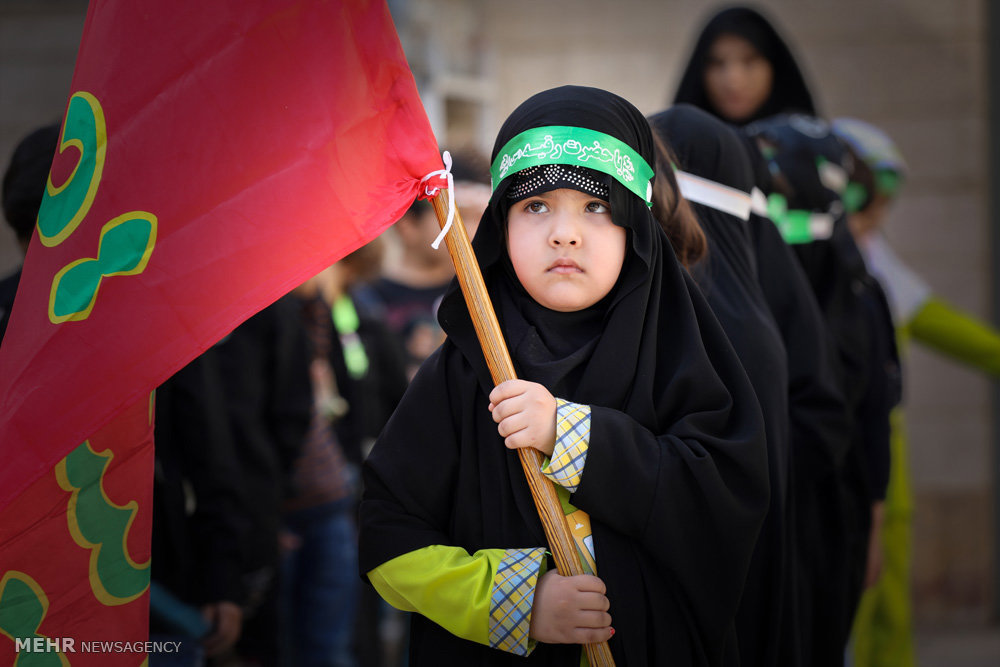
leave.Children have usually attended religious gatherings and groups and have heard about this from speakers and eulogists, and they are not unfamiliar with this event. Bringing this story into the realm of literature makes it more difficult to write.
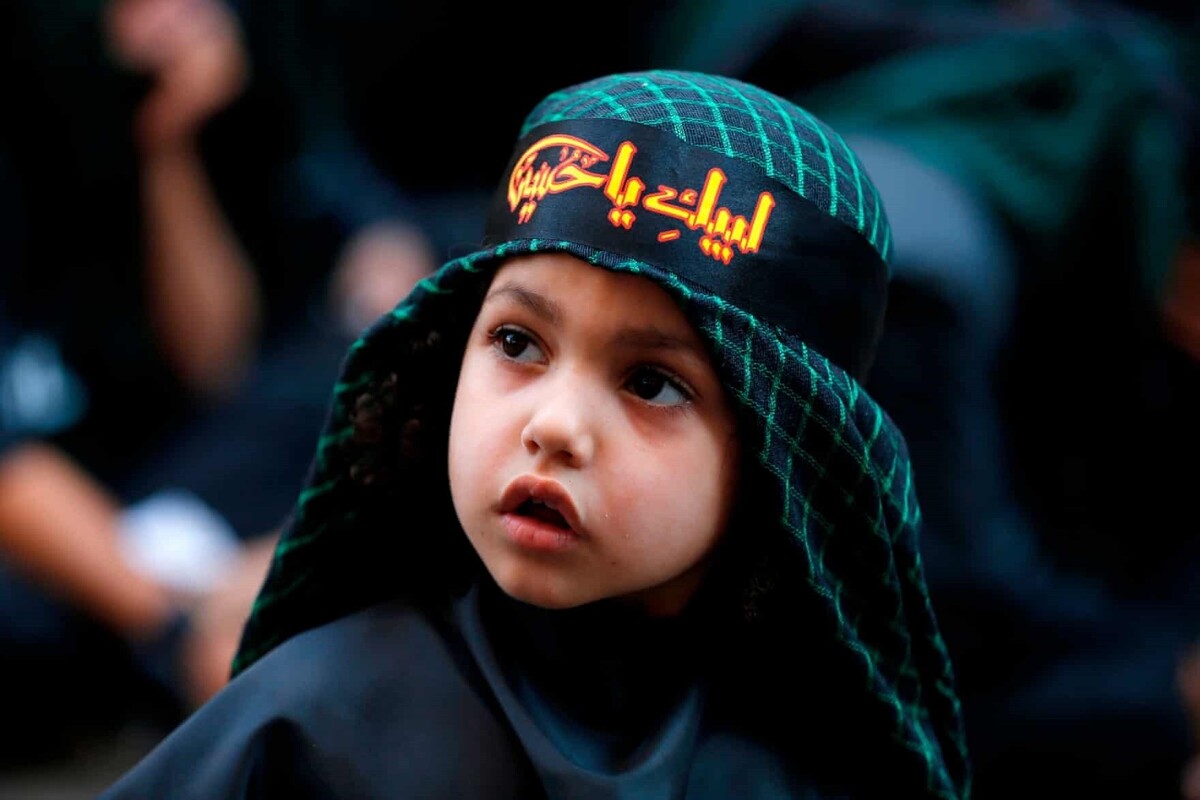
According to the reportSpecialized Association for Children and MediaWriting and composing about Ashura is very difficult for children, difficult in that you have to both show the greatness of Karbala and its lessons, and also portray an image of the event that is not very compatible with the age and mentality of this age group, especially children. Furthermore, this Sunni group must somehow understand the philosophy and purpose of this historical event in stories and poems and believe that part of this message lies in the very aspect of the injustice of Imam Hussein and his companions and the oppression of the Yazidis. Therefore, it is very difficult to combine the two, and that How to convey the violent dimensions of the Ashura event in poetry and fiction in a way that bridges the gap between imagination and reality, while also taking into account the child’s emotions, requires elegance and art.
Mustafa Rahmandoost has two poems about Ashura, called “Lullaby of Ashura” and “The Story of Water.” “Lullaby of Ashura” is from a mother whose child is not sleeping and she tells the story of Ashura in her lullaby to put him to sleep, and “The Story of Water” is written for teenagers. It is a story of water that has not been able to reach the martyrs of Karbala and is ashamed in front of Imam Hussein (AS) and his companions.
The poet emphasizes an interesting point and says: “It is not enough to just say that Imam Hussein (AS) was martyred; they must say something that children can understand and comprehend. I do not know how to speak to children, because I do not have a mind based on science and knowledge. I myself work very hard.” I did; it took me maybe seven or eight years to figure out how to write!
I have seen books in the field of children’s literature that show the head of Imam Hussein (AS) on a spear, with blood dripping from his head; this is very terrifying for children. Such depictions do not give greatness to Imam Hussein (AS). For children, the hero is important. In the eyes of children, Anyone who finds themselves in such a situation is not a hero!
“Perhaps the resistance of Imam Hussein (AS) and his companions and their refusal to accept oppression can be described as the characteristics of a hero. A writer or poet cannot simply simplify the story a little, but tell the whole story; this is not the right way.”
Since children have usually attended religious gatherings and assemblies and have heard about this from speakers and eulogists, and are not unfamiliar with this event, bringing this story into the realm of literature makes it more difficult to write. But what can we do to believe? Is it only literature that keeps historical events in mind and actually gives them legitimacy?!
Here, it is important to remember that in children’s literature, with historical and especially Islamic backgrounds, authenticity is also a serious criterion for credibility, and from childhood, the sources of distortion can be dried up, an issue that is very prevalent in the story of Ashura. It has become our obsession, and part of the duty of literature in the field of children and adolescents is to pay serious attention to avoiding any kind of superstition and distortion.
We know very well that literature deals with metaphor, and the subject of Ashura is somewhat softened by the use of metaphor due to its sensitivity. If you remember, you know that the late Qaiser Aminpour wrote the poem “Ney Nameh” for adults, but In it, he uses the metaphor of “rain”; in this collection, rain is sometimes a symbol of Imam Hussein (AS) and sometimes it is the rain itself. This approach can be well used in children’s and adolescent literature.
Another issue that should not be overlooked is that today, in addition to paper publications, cyberspace is also a vast field in which children’s and adolescent literature should not be forgotten, and content production for this field is as important as the paper medium.
Below, we will take a look at just a few examples in this field from the extensive list of works for children and adolescents. **

“Stories from the life of Imam Hussein (AS)”
In this book, Mahmoud Pourohab has narrated stories from the life of Imam Hussein (AS) from childhood to adulthood in an eloquent language. The book is also accompanied by illustrations suitable for children, which makes the child more eager to read it.
“Tales of Ashura”
Fariba Kalhor has dealt with the influential figures of Ashura and their connection to Imam Hussein (AS) in ten volumes (which are also included in a volume called “10 Ashura Stories”). The author uses a fluent language that is suitable for the age group of children, accompanied by illustrations by Seyyed Hossam al-Din. Tabatabaei has tried to connect children with the event of Ashura, the famous and brave people of the tenth day of the year 61 AH, and Imam Hussein (AS).
“Imam Hussein (AS) for elementary school students”
Hossein Fattahi has narrated the life story of Imam Hussein (AS) from his childhood to his martyrdom with an accurate and documented narration. While respecting the authenticity of the historical events of each story and mentioning the exact names of the characters, places, and dates, the author has also tried to preserve the narrative aspect of the work. Don’t ignore.
“Rain in the Tent”
This book is in the field of poetry and is published by “Surah Mehr” and is written by Mehdi Mardani. It uses childish language to address different topics surrounding Muharram in thirteen poems.
“Illustrated Story of Ashura”
Written by Mohammad Saeed Bahmanpour for the teenage age group. The difference between this book and other books in this field is that it narrates the event of Ashura with pictures. Parviz Eghbali, with appropriate illustrations, accompanies teenagers with the Ashura caravan and helps them to better understand Muharram of the year 61 AH helps.
“Children of Ashura”
This is a book by Be Nashr for children and teenagers, which can be a good source of useful information in this field. In this work, author Tahereh Ebod has tried to tell the story of the teenage martyrs of the Ashura uprising to children in a childlike manner.
“Forty Days of Love”
It is published by the “Center for Intellectual Development” and was written by Mohammad Reza Sangari in 2010. This book is about the events and incidents after the martyrdom of Imam Hussein (AS) and his companions until Arbaeen. The author describes the situation of each of the survivors of the Ashura movement during these forty days. has stated.
“Thirsty Lips”
The “Center for Intellectual Development” published this book in 2012. In this work, the author, referring to the most reliable sources of the history of Ashura, has narrated the events of this great day with precision and detail. This book is actually considered one of the “murder” books in which The events of Karbala and the names and manner of martyrdom of the epic writers of Ashura are described. Also, poems with verses appropriate to the subject by poets such as Hafez are included in this work.
“Cry Bloody Sky”
Written by Jafar Ebrahimi and published by the “Center for Intellectual Development”. In this book, the epic of Karbala and the martyrdom of Imam Hussein (AS) and his companions is narrated in a simple manner, along with a few pictures, for the Sunni youth group, in 10 sections titled “Hussein is on the way”, “Martyrdom” Muslim and Hani”, “Martyrdom of Muslim Children”, “Movement of Hussein (AS) towards Kufa”, “Land of Karbala”, “Night of Ashura”, “Evening of Strangers”, “In the Palace of Yazid”, “The End of the Good and the Pure and the End of the Wicked and the Impure” and “Poem of the Evening of Ashura”.
*It is part of “Lullaby of Ashura”, composed by Mustafa Rahmandoost.
* This section is adapted from the IBNA report titled “What books should children and teenagers read during Muharram?”