
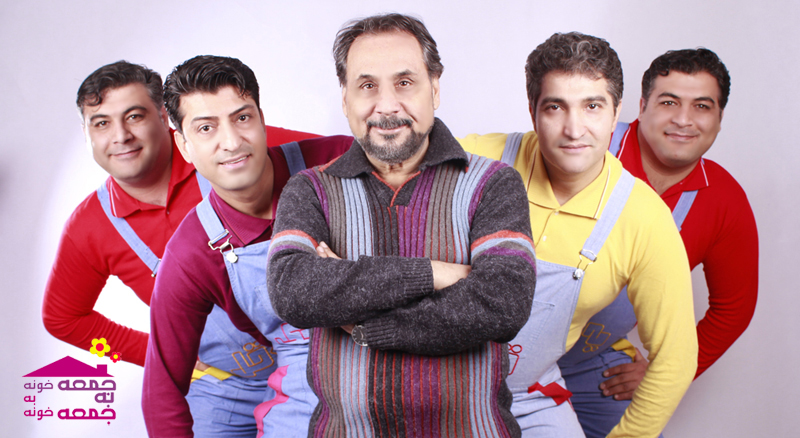
Review of the TV program “Khooneh Be Khooneh, Jomeh Be Jomeh”
Introduction
Half a century has passed since the introduction of television to Iran. During this interval, the production of children’s programming, which is the most important and strategic programming in the Islamic Republic of Iran Broadcasting (IRIB), has seen many ups and downs, among which the 1980s is considered one of the golden periods of children’s programming. The production of popular programs in the last decade across national networks confirms this claim.
Meanwhile, one of the most successful children’s programs on television in the 1980s was Uncle Ghannad’s programs, which started with “Fitileh, Jomeh تعطیله” and is currently airing under the name “Khooneh Be Khooneh“. Following the decline of some popular children’s programs, this program began on Channel 2 of Sima, hosted by TV presenter Majid Ghannad, who has 30 years of experience in producing children’s programs and successfully managed to maintain and increase the audience for children’s programming.
Since any program produced and broadcast requires expert work and an examination of strengths and weaknesses for further qualitative improvement, this program, like others, must be critiqued and reviewed from various dimensions, especially since the planners, policy-makers, and producers of the national media pay attention to the quantitative and qualitative enhancement of IRIB’s programs. For this very reason, Channel 2 of Sima, as a network known as the Children’s Network, takes an expert view of children’s programs—which are considered among the most important groups of programs—and pursues this in order to elevate the level of these programs.
Along these lines, this article attempts to evaluate the program “Khooneh Be Khooneh”. This text, which is the result of a session held to review this program, is presented as an introduction to this series of reviews. It is hoped that this critique and review can assist the managers and producers of the Children’s Network in the path of upgrading the level of children’s programs. Essentially, dedication to the rising generation and children is considered a sign of a nation’s progress and development and shows that nation’s foresight and forward-looking vision regarding its own destiny.
1 – A Glance at Identifying the Format of the Khooneh Be Khooneh Program
Such programs are TV variety shows, which as a format in program production are one of the best methods for conveying concepts and attracting children in television structures. By definition, a composite program or TV variety show is a mixed program with a mosaic structure whose segments revolve around a specific axis.
Most variety shows try to instill the appropriate message to the child by encompassing dramatic pieces, music, reports, and animation around a specific axis. Each of the segments differs from one another in terms of presentation form and duration, but ultimately, they fit within a framework, and the message is repeated logically with its own weight across all segments. Variety shows, based on the fourfold goals mentioned in the revision and drafting plan of IRIB’s production standards, include instructional, informational, educational, and entertainment, which are categorized into dramatic and non-dramatic program sections. (Hosseini, 2006, p.)
Globally, there are prominent programs in this field, one of the most important of which is called “Sesame Street”, which due to specific aspects of television education in the world is considered a major transformation factor in the field of production for children.

2- General Requirements and Upgrading Children’s Programs
The upgrading of children’s programs generally requires conditions that addressing and paying serious, continuous attention to them must always be a priority. Among these requirements, the following can be mentioned:
A) The need to identify the psychological characteristics of target children
One of the issues raised in the field of communication is the category of audience research. This category oversees the examination of target audiences’ characteristics and, in most cases, examines the demographic, geographical, and psychological characteristics of the target audience. Audience research is necessary for producing all media programs; because without it, we may not succeed in the sphere of influence or we might even go astray. Its absence can have a negative impact on a program’s appeal; because when we do not know our audience correctly, we cannot make correct decisions regarding the use of various appeals either.
Based on this, one of the vital requirements in the field of children’s program production in the national media is the need to identify the target child, namely the Iranian child. We must know our target child in terms of spiritual and psychological characteristics such as interests and thoughts, expectations and behavioral and intellectual changes, needs, level of perception and understanding, or type of worldview so that we can organize our program in alignment with them. Such research regarding children must always be updated; because in some areas, these characteristics are subject to change over time and according to the requirements of the times.
Therefore, one of the necessities is to have comprehensive information about the characteristics of the target child and to always update this information. It is worth mentioning that some characteristics referred to in psychology books cannot be considered as fixed characteristics of children or as the characteristics of all children around the world. Therefore, program production relying solely on them will not be sufficient. Many of these characteristics may pertain to children in one part of the world. For example, some interests mentioned for a child pertain only to Western children, whose research was conducted in their environment.
B) The need to identify the method of children’s program production
The second and essential requirement in this field is that after identifying our target child, we must know the methods and principles of program production for this child. It is necessary to carefully and insightfully adapt the methods to the defined child, and if we adopted a method or format from elsewhere, redefine it according to existing conditions so that localization takes place.

3- Review of the Khooneh Be Khooneh Program
A) Introduction
B) Examination and explanation of the program’s strengths
C) Examination and explanation of the program’s weaknesses
A) Introduction
Undoubtedly, one of the important and influential factors in the education and upbringing of children in today’s world is the media. Today, visual media, especially television, have opened their way as a family member inside the home and have affected the educational atmosphere of the family with their presence. The diversity of various television programs and their quantitative increase have created new challenges facing families. It should be noted that the inappropriate planning of program production actors causes serious problems in the education and upbringing of children. Therefore, an expert approach to the structure and content of children’s programs can increase its benefits and reduce its harms.

B) Examination and explanation of the program’s strengths
Among the positive points of the program that need to be followed up and strengthened, the following can be mentioned:
One – Use of an animal puppet
Children, especially at a young age, are interested in stories in which an animal features as one of the characters, especially if that animal also speaks. Hence, the presence of an animal puppet in this program is one of its strengths that is better to be reinforced. In general, it must be kept in mind that children are animistic and establish good connections with objects and puppets that exhibit human movements like talking. Therefore, the presence of puppets in the program is beneficial.
Two – Integrating education and entertainment
One of the strengths of the Khooneh Be Khooneh program is the integration of the educational aspect with entertainment. The sign of this orientation, which in recent years has become more visible in special children’s programs, is the increase in religious programs for children and teenagers. This subject is important from the perspective that this action is a step toward realizing the religious media; because the religious media considers for itself an educational status and purpose.
On the other hand, considering that most visits to television, especially by children, are for entertainment, this action causes more child audiences to be attracted to TV programs and exposed to television education. Of course, children’s visits to television are not just for entertainment, and based on research conducted, other factors such as discovering facts and daily realities, experiencing the realm of imagination, identification with its characters, education, passing time, recreation to forget problems, learning about oneself, excitement, relaxation, companionship, and habit can also draw a child toward television.
Three – Employing art in education
One of the methods for conveying moral and educational values to children is using the language of art. The use of artistic structures and attractive techniques, and the use of colors, poetry, and music play a significant role in children’s learning. This program also strives to use this tool and step in this direction by proposing appropriate subjects for children’s education and upbringing, such as health, rule-of-law, and adherence to religious, social, and moral values.
Four – The presenter’s capabilities
The presenter (Mr. Ghannad) is influential and relatively successful in creating order in the program, direct communication with the children present in the studio and the viewing children, and consolidating the concepts conveyed through poetry or performance for children; meaning the presenter is a corrector, completer, and consolidator of children’s perceptions from various parts of the program. Another strength of the presenter is his eloquence and attempt at education in practice. For example, when calling children to exercise, he himself joins the group in exercising and moving.
Five – Utilizing performance
Children learn and remember more subjects and concepts through performance compared to methods like simple expression, lecturing, or preaching. Therefore, an appropriate and attractive performance group in the work of execution and education greatly helps improve the quality of children’s programs, which is considered one of the positive aspects of the discussed program as well.
Six – Using the poetry format
One of the important formats in conveying concepts is the poetry format; because concepts in this format are more impactful and enduring in the audience’s mind. The application of poetry in working with children is also very appropriate and fitting, which is observed in this program.
Seven – Presence of a contest in the program
In addition to entertainment, it is very effective in creating joy and excitement in children. Another strength of this program is the utilization of the contest element. A contest, in terms of excitement generation, will also make the program more attractive; because it contains a kind of emotional appeal. Emotional appeals include creating appropriate feelings in the audience by turning to feelings, values, or excitement and placing them in a pleasant state when receiving the message.
Eight – Addressing occasions
Another positive point of the program is addressing various occasions of each week, even by stating a short sentence such as congratulating Doctor’s Day. With such reminders, both the ground is prepared for children’s familiarity with these occasions, and children learn respect and valuation for them.
Nine – Addressing different ethnicities
Addressing different regions and ethnicities of Iran in the form of poetry and greetings is another attraction and positive manifestation of this program; because in children, in addition to creating awareness, it arouses a sense of respect for all ethnicities.
Ten – Expressing and repeating moral and religious values
Stating moral and religious values such as respect, gratitude to God, and prayer are also among the program’s strengths. Another important point associated with this strength is the repetition of these values in various programs, which has a suggestive effect on the child’s psyche and provides the possibility of internal and psychological transformation in the child. Essentially, suggestion is one of the educational methods emphasized by Islamic foundations and psychological principles.

C) Examination and explanation of the program’s weaknesses
Despite the positive points observed in this program and incorporated by the producer in their program, there are also weaknesses that can be pointed out:
One – Failure to establish complete communication with the child audience
Communication is not merely the transfer of a message from a sender to a receiver, but in the meaning of communication, creating semantic similarity between the sender and receiver is also a condition, and essentially the greater this similarity, the more complete the communication established. In this program, because some of the presented messages are higher than the child’s level of comprehension, complete communication regarding all messages is not established between the child and the media; because essentially regarding such messages beyond the child’s level of comprehension, semantic similarity does not occur.
For example, sometimes during the program, hadiths are brought up that are beyond a child’s comprehension and require exposition appropriate to a child’s understanding. Essentially, knowing the child’s language and linguistic similarity in presenting material to children is an important element in conveying concepts to children, to which religious sources pay attention and emphasize. Child educators must be familiar with children’s feelings and inclinations, understand them, and properly know and use child language.
Since you fell to dealing with a child, then you must speak the child's language
Two – Defining the audience in a general sense
This program in a way does not consider its audience to be solely children, and as can be gathered from its content, it has considered both children and non-children as its audience. So in a way, it considers a general audience rather than a specific child audience. This issue contradicts the necessity of media programs becoming specialized in terms of audience, which can be justified and interpreted given the differences among audiences in capacity and level of comprehension.
In other words, it can be said that one of the primary weaknesses of this program is the unspecified age group for which the program is made. For example, the cartoons broadcast are for different age groups; the cartoon “Road Repair Shop” is more suitable for preschool children and early elementary school years, and “The Legend of the Three Brothers” is suitable for teenagers and middle school age groups and above.
It must be kept in mind that such program production, considering that it also raises some issues related to and at the level of adults, can lead to the eclipse of childhood; because by raising certain adult issues, it destroys the distance between child and adult. Childhood means the world of imaginations and fantasies and the world of childlike feelings and thoughts, and this period eclipses when nothing remains of the child except a creature with adult desires, and what passes in the child’s mind and thought are the dreams of the adult world.
Accordingly, sometimes this program addresses topics that lack appeal for children and are not among children’s priorities; topics that might only be attractive to older people. For example, in the program dated 8/27/2012 [3/6/1391], the presenter asked the husband of a lady who had previously been invited to Mr. Ghannad‘s old program in the 1960s: Did you think you would marry this lady who was invited to a program in her childhood?
Three – Single-gender nature of the program
This program functions in a single-gender manner; because we see no trace of the female gender among the main members of the program, which are the presenter and the performance group. In addition to gradually creating a kind of patriarchal belief in children’s minds, this matter causes problems for girls in role-modeling from this program; because based on psychological foundations, a child role-models someone who is similar to the observer in gender.
Four – Lack of sufficient motivation
One of the fundamental principles in the learning process is creating motivation in the learner. In the educational process, it is necessary in the first step to create the motivation for learning and an internal inclination to learn in the education audience. First, an issue must take shape in the child’s mind, and later we should seek to answer it. Meanwhile, in this program, in most cases, education is pursued by presenting material before creating motivation.
Five – Lack of objectification
Objectification, in one sense, is accompanying the teaching of concepts with matters that are not easily forgotten or with which the child deals frequently. This aspect of objectification causes the intended teaching to be forgotten later or, if forgotten, to be remembered sooner. As observed, the use of objectification is less visible in this program, as a result of which the process of education for the child remains incomplete.
Six – Multiplicity of subjects presented in a single program
In this program, various and multiple topics are brought up during a single episode, which is a psychological mistake; because a child needs time to be able to comprehend what they hear. Therefore, bombarding the child with information causes them to be unable to understand the material properly. It must be kept in mind that when all parts of a program focus on a specific subject, that subject and educational concept settles in for the child more, and the child is more influenced, than when each segment follows a different topic.
For example, in the program of August 24 [September 3], three topics were addressed: Iranian accents and their importance, medical issues and observance of hygiene, and traffic rules, which is very much for a child. Of course, there are other sub-topics in the program as well. This issue also existed in the program of August 31 [September 10].
Seven – Prescriptive and directive nature of moral and educational recommendations
In many programs made for children, including this program, we witness messages that directly and prescriptively present moral and educational messages. For example, on August 24 and 31 [September 3 and 10], an item titled a narration from the Prophet was presented as a caption and narration, which was left without any introduction or conclusion, and considering that presenting religious concepts to children is very difficult, no explanation was provided about this narration and the concepts presented in it, such as piety.
This is while essentially such messages are better taught to children indirectly and in the form of performance. Because based on some research conducted, children’s inclination toward performance programs is greater, and the more programs approach a narrative and conversational state, the amount of attention from child and adolescent audiences decreases.
Eight – Excessive use of music
It seems this program has based one of the pillars of its appeal on music and consequently utilizes music abundantly. This issue is undesirable given the unfavorable effects music can leave, especially since these musics are not even made specifically for children.
In this program, like other programs in the children’s section, music dominates the content of musical works, and it can be said that the poetry gets lost in the music, and the singer and director perform more under the influence of the tune than the content. Another point about this is that the music present in this program, like many other programs, pertains to the adult age group. One must ask: what affinity do these fast, ring-toned musics with lyrical quality have with the world of children? This is while the production of children’s music is now considered an independent discipline in the world.
Nine – Non-interactive nature of the program
One of the important issues in the program is that the program is not interactive at the level of the children present in the studio as well as its audience, and less interference and presence of the audience and attendees is observed in the program. As observed in this program, the role of children present in the studio is generally summarized in clapping and screaming. Accordingly, it is necessary to use programs such as contests, phone calls, letter writing, and listening to the opinions of present children regarding the discussed topics.
Ten – Weak role of the puppet present in the program
Puppets with their attractive appearance and suitable voice can come to the presenter’s aid in the execution work and make the program more attractive. One of the problems of this program is the weakness of the puppets in appearance, puppet handling, voice, and also in their faint and weak role, in such a way that children do not establish a connection with them. For example, in the program of August 24 [September 3], a puppet named Kонjаd [Kondjoud / Sesame] performed a program in an item carried out with the accompaniment of one of the children inside the studio, and it was clear that despite the acting presented with the lady doctor and the child actor, even the puppeteer had no possibility of connecting with the child by any means.

4- Suggestions
In addition to structural and artistic reforms that are debatable in their own right, paying attention to the following points, which are derived in a way from the preceding materials, can help improve this program:
A) Considering the present and future needs of children, a kind of comprehensive view in children’s upbringing and educating them must be pursued. Accordingly, addressing issues such as a sense of responsibility, patience and endurance in the face of difficulties, avoiding greed in various dimensions, fostering rationality, and promoting thinking are recommended. Another item that children should learn alongside their play and joy, and which this program needs to consider, is being calm and practicing tranquility.
Sometimes parents and those around ask children to be calm. Hence, it is appropriate that in addition to joyful and lively programs, parts of the program also address this matter. This is while in most television programs, children’s accompaniment with the program is synonymous with asking the child’s first and last name, place of living, and more importantly, screaming and shouting and clapping. This issue, with today’s lifestyle, is perhaps in a way a method for the spiritual discharge of a child living in an apartment. It must be noted that in some cases, one must also think about moderating the child toward calmness. For instance, the story of “The Quiet Star” in Western texts teaches the child that sometimes one must approach certain issues with tranquility. Teaching tranquility on Iranian television is considered one of the major gaps.
B) Using children in performances and content-oriented anthems also adds to the program’s appeal and if properly guided and the poems are correctly selected, it can have a kind of suggestive effect.
C) Introducing suitable models proportional to the age of the child audience.
D) To solve the problem of single-gender dominance in the program, it is recommended that a performance group of the female gender be present in the program, which of course must execute performances appropriate to the female gender and girl characteristics.
E) Focusing on fewer topics in a single program and avoiding multiplicity of topics.
F) Strengthening the role of the puppet in the program.
G) Benefiting from the role-playing method and objectifying value concepts by the children themselves.
H) Challenging certain negative anti-value behaviors and analyzing them through the children themselves and stating their consequences. This also helps strengthen the child’s faculty of reasoning.
I) Using simple and understandable concepts appropriate to the child’s capacity and need regarding religious beliefs and prayer.
J) Using stories and parables present in Islamic and Iranian literature.
K) Focusing exclusively on the child audience.
L) Observing and teaching the Islamic lifestyle in recreation, joy, and social relations.
M) One of the vacant positions in this program is the position of storytelling; a category that has both been attended to by religious teachings and extensively addressed by psychologists and child educators. This gap can be filled by the presence of a storyteller aunt, which would also compensate to some extent for the defect of women’s faint presence in the program.
N) Using indirect methods in presenting religious concepts: a religious message is not solely one that contains direct religious teachings like a narration from the Infallibles, but any message that somehow draws the audience toward a religious life and the realization of religious ultimate goals in life is considered religious. Accordingly, direct quotation of religious teachings is not necessary for a program to be religious, although sometimes it is necessary as well. Meanwhile, it must be kept in mind that a religious message is not just religious rituals. Accordingly, it should not be summarized solely in rituals.
O) One of the influential aspects in the program is design and decor. Changing the decor and space can add to the program’s appeal. For variety, performing in open spaces and nature is recommended.
P) One of the beauties of this program is introducing various regions and ethnicities of Iran, in which section, when reciting poetry about each region, the performance group introduces the traditional dance of that region of the country as a symbol, whereas by utilizing children holding clothes or symbols like pictures of great figures of those regions of Iran, while conveying appropriate symbols, children can be made familiar with the cities and great figures of that region and even their historical monuments, or instead of showing traditional dance, other customs of the mentioned regions can be incorporated into the performance.
Q) The children present in the program can play a more active role by participating in contests and appearing in performances and cause the program’s appeal. It is also necessary to consider ways for child audiences to communicate with the program.
R) It is recommended that to create motivation in the child, which is a prerequisite for education, a conflict be created between the child’s needs and what is presented. This can also make the program more attractive. Another way to create motivation is to use the child’s inquisitive nature and pose questions before presenting educational material.
References
1- Hosseini, Negin. 2006. TV Variety Show for Children. Tehran: Ettela’at.
Authors:
1- Seyed Yasser Hosseini
2- Morteza Haddadi Pisheh
3- Ghasem Karbasian
4- Fatemeh Ramezani
5- Mahmoud Alipour
6- Ehsan Shariati Najafabadi
1- M.A. in Educational Sciences, Value Education Orientation, Imam Khomeini Educational and Research Institute. hyas58@yahoo.com.
2- M.A. in Educational Sciences, Value Education Orientation, Imam Khomeini Educational and Research Institute. hadadi@qabas.net.
3- Graduate of Level 3 of Qom Seminary and M.A. in Communications from the Faculty of IRIB gkarbasian@yahoo.com.
4- Ph.D. Student in Philosophy of Education, University of Isfahan, M.A. in Educational Sciences, Preschool Education Orientation, Allameh Tabataba’i University. framezani.1390@yahoo.com.
5- Graduate of Level 3 of Qom Seminary and M.A. in TV Production khashab@gmail.com.
6- Graduate of Level 3 of Qom Seminary and M.A. in TV Production e.shariaty@gmail.com.

Scientific-Specialized Quarterly of Child, Adolescent, and Media
Year 1, Number 4, Summer 2012
Pages 137-155