
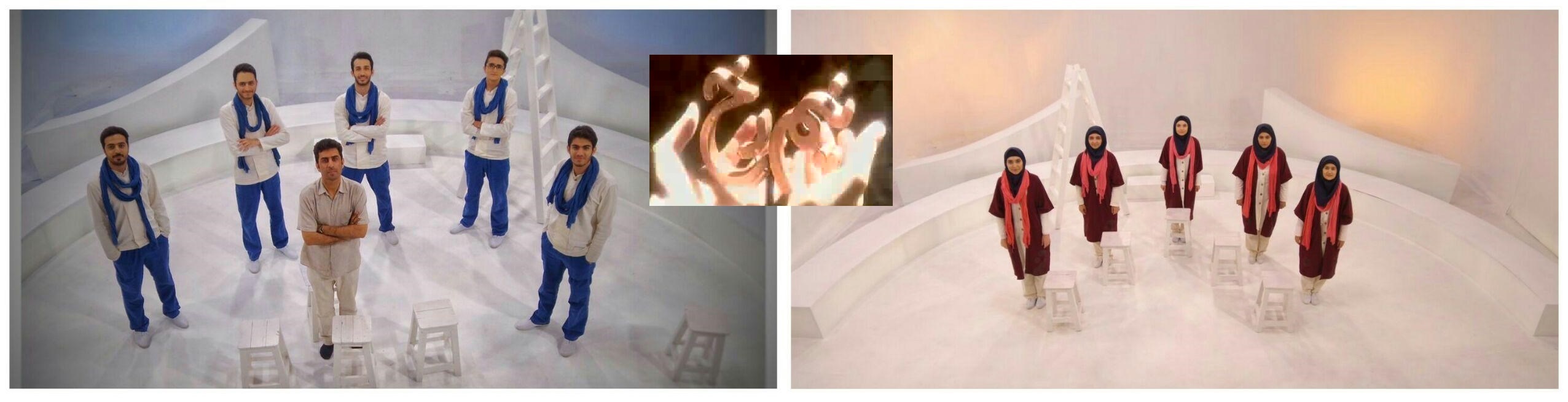
A Brief Introduction to Professor Asadollah Alaee
- Bachelor’s degree in Graphic Design
- Master’s degree in Communications
- Head of Children’s Group at Channel 1 and 2 for 18 years
- Designer, writer, and producer of Nimrokh program

📽 What makes a successful program?
Every television program has standards, part of which relates to the program’s audience. Depending on the audience the program has, it finds a specific direction for that audience. The characteristics of the program relate to the characteristics of the audience, and for children as well, considering the audience of that program who are in different ages, it must possess features that respond to the audience of that age group. In terms of content, the objectives anticipated in the program must also be appropriate for the audience.
Overall, a successful program is one that, considering its anticipated objectives, can connect with the audience and achieve its goals, and if it has a specific theme or behavior in mind, it can convey that theme to the audience to some extent or bring the audience’s behavior along with it to some degree. Technical and artistic standards must also be observed. The concepts and topics we choose must be appropriate for the audience. And audience awareness must be taken into consideration.

📽 How can we know if a program has been influential?
Well, there are mechanisms outside of production, and research centers within the IRIB monitor the success or failure of a program through research and surveys they conduct. Of course, program makers try to observe certain principles and pay attention to indices before making the program so that they can have the desired impact.

📽 In your opinion, in program making for children, can moral concepts be conveyed to children? If yes, what regulations and criteria do you suggest for doing so?
Certainly, moral concepts are also among the topics considered in children and young people programs, and in any case, in the field of children and young people, the approach of programs is educational, and morality is one of the topics considered in education and upbringing. However, as for which themes and subjects to choose from morality and moral topics, naturally, firstly, there must be a prioritization, and secondly, morality includes two domains: prohibitive and affirmative. That is, things that a child should do and things that a child should not do, and the approach should be in the affirmative domain, meaning we should teach children the things they ought to do. That means talking about honesty, and dishonesty automatically becomes bad. The third and most important point is to turn concepts that have a mental and abstract aspect into a skill, and present them as a skill using concrete examples that exist in the children’s own lives. Such as the skill of telling the truth, the skill of respecting elders. Fourthly, working on examples that we see and observe in children’s lives, and not talking to children about general concepts and generalities. And we must use methods that allow us to have the necessary impact on the child, rather than just presenting it as a slogan and generalities.

📽 From your perspective, which of religious moral concepts can be presented to children? If you differentiate for various child audiences (toddlers, children, and young people), what factor do you see causing the distinction of this categorization for each?
Certainly. In choosing a topic, we must have a prioritization, a large part of which relates to the child’s needs at that specific age. For example, for a toddler audience, let’s address concepts that revolve around the relationship between mother and child. And as children grow older, we address concepts that encompass a broader circle of society. For example, in adolescence, we address moral concepts related to communication with various social groups and peer interaction. And the techniques we use in children’s programming differ from the methods we use for adults. One of the most effective methods in conveying moral concepts, which is also indirect, is the method of narrative and storytelling. By using stories, characters are created where these very characters, incidents, and adventures in the story convey these concepts. The storytelling format is a very good format, but at the same time, it does not mean that we cannot express moral concepts in direct communications. However, the speaker must have certain conditions, from literature to their expression style, so that the direct mode of expression is eliminated. And the important point that I emphasize again is that we must turn moral concepts into a skill, make them practical, and express them as skills for children. For example, the story of Prophet Joseph (PBUH) where when he faces sin, he resists from the very beginning, and we teach the audience the skill of resisting sin, unlike many stories where the story character commits the sin first and at the end, with a minor or major transformation, becomes honest, pure, and righteous. We must teach the skill of ethical communication with others.
📽 Is expressing the prohibitive thing not more attractive?
This is also a method, but in my opinion, if expressed prohibitively, we also introduce a lot of bad teachings.
📽 Can it be said that some formats are closer to the religious approach and their potential for housing moral content is greater? If yes, which formats? With what characteristics?
Sometimes certain themes are imperceptible and intangible, perhaps we should use formats that are indirect. For example, it might seem unlikely to use a documentary format because lying is a bad act, but you might easily address this concept in a dramatic program or even a stand-up. Each of these formats has its own effect; for example, through direct communication you can convey more information about a moral theme, but in a dramatic work you cannot convey such vast information, give numbers and statistics, whereas in a direct work you can provide a bit more quantitative information to the audience in a more face-to-face and direct manner.

📽 So that means every concept chooses its own format?
No, we need to see what we want to do; for example, you see, if one time you want to bring tears to the audience’s eyes, you use more emotional methods and mechanisms, and another time you want to reason with the audience using these moral concepts and speak somewhat more rationally, you go and get reports. For instance, you excite the audience by showing reports of accident-involved children whose hands, due to not listening to parents, went into a meat grinder or fell from a tree, thereby causing them to accept this concept. Overall, I feel that every format has its own function, and appropriate to the audience and the goals of the audience and the program, we choose a structure and format. And we must also know that basically we should expect from various media according to their own scale. Television’s capacity is limited, radio’s capacity is limited, a book’s capacity is limited, and limited in the sense that they have a specific capacity, just as the capacity of a gathering held in the local mosque has another capacity, the capacity a teacher has in the classroom is different from other media, and these are totally different educational and media capacities that we must expect from them in proportion to their capacity and function. Sometimes we expect the television medium to express moral concepts that influence a child, while they should learn this concept from their mother, their teacher, the mosque cleric, or their friends. Furthermore, television audiences are also diverse. Many audiences are more educated, more moral, while many audiences are the opposite. And a general rule cannot be made regarding influence on everyone, and sometimes this influence also depends on the time and conditions under which you are broadcasting the program.
📽 Which genre (comedy, fantasy, musical, action, slapstick, etc.) of programming has greater potential in attracting children? Why?
Each of these has its own capacity and function, and I don’t have much preference for going towards specific genres to convey moral concepts. But the action genre seems attractive for teenagers, and Pink Panther and Pat & Mat, which are funny actions, are attractive for children. However, all of these are subject to their own specific technical principles, which, if well observed, can be influential.

📽 Name a few important and influential features in the “Nimrokh” program that you think help attract the audience to this format, and if possible, explain why you think this feature helps?
The first issue that made the “Nimrokh” program influential was that we tried to have something to say. The program’s effort to give useful information and messages to its teenage audience was the most important factor in the success of the “Nimrokh” program. The work was very intense, and although I had executive engagements, I had to do the research. And one of the reasons I produced this program was that we wanted to talk seriously to teenagers for the first time, and many also said you would not succeed. And this very thing led us to pursue talking seriously to teenagers, and for a week we would talk to children about identity, or we would talk about the value of thinking in our lives for a week.

And many of these topics were extracted from Martyr Motahhari’s (RA) education book and raised in the program. And after two months when our work loosened up, I still hear the voice of that young lady in my ear who had called and said: « Nimrokh! Your talk is over now. You have nothing else to say. » Meaning an expectation was created in the audience where they wanted fresh, new, and deep talk from the program. And how we should say these things became our other issue. And we used various methods to talk about topics. For example, we wanted to talk about identity, which is why we looked for concrete examples of identity in people’s lives. And we wouldn’t come out and say we want to talk about identity. Instead, we talked about birth certificates, and for a week the subject of our program was the birth certificate, and automatically and indirectly all the items we had in mind about identity were conveyed to the teenage audience through this method. Or we used educational aids or specific phrases. One of the phrases I remember the writer played well upon was this phrase: « Nahnu Abna’ al-Dalil ». And we used these novel methods in conveying concepts. The third issue I want to present to you is that we interacted with teenagers, making our communication two-way in a way that we empathized with them. Because teenagers at this age feel that no one pays attention to them and they feel lonely, needing a confidant whose lap they can even lay their head on and cry. And our effort was to empathize with these affections and emotions. And we used very simple things too. I remember we had said this program would not be broadcast for two weeks when a young lady called and started crying, saying « Why isn’t it airing, I have grown attached to you ». True, we do journalistic work, but our goal from airing this young lady’s cry was not to gather an audience; rather, we brought a large number of people who sympathized with this lady along with us this way, meaning we empathized with them. Meaning this very reinforcement of two-way communication and interaction with the teenage audience, and most importantly giving credibility to their personality, was what attracted them. And this instilled in them the feeling that there is a place where you can say whatever you want and unburden your heart however you wish, and we had transmitted this sense at least. Through the signs and signals we gave, we caused the teenager to accompany us. Sometimes I remember the gentleman who was the deputy of television told me: « What does this program have that has so many devoted fans? » Some audiences were truly devoted.

Of course, the opposite of these audiences were people who cursed at us, and both mattered to us. And that audience reacted this way because they didn’t like some of the content. For example, we had a topic like clothing, and they had a different lifestyle and clothing, and their taste was different and they didn’t accompany us. Or perhaps that audience simply wanted to watch a sports program, but here we were talking about culture and morality. But they engaged, and the reason was empathizing with teenagers. It has been said that «young children are closer to the family, in childhood they are closer to the educational system and influenced by school, and teenagers are more influenced by society and their peers», and we tried to be part of the teenagers’ peers in a way, and this was the factor of the program’s success. And in writing, techniques were used where we made direct speech indirect in a way; for example, the writer had created a character through whom we spoke our words. There was a character named “Naneh Jan” who in one episode had gone to the butcher shop, bought meat, and brought it home. And a world was created in the children’s minds even though there was no external character. Now this “Naneh Jan” who had bought a bunch of meat and brought it said to herself, what should I do with these, and said I must chop these up and categorize them. Well, what was the subject of our program? Planning. And we said it like this: if you intend to solve a big issue, first you must divide it into smaller issues, and by using this method to introduce the topic, it was somehow close to storytelling and engaging for the children, and the topic was brought up. Or I remember we started a storyline that took two weeks, and I think I wrote the text for this part of the program, where we were entering the 21st century from the 20th century and were riding an airplane, balloon, or something, and wanted to explain this transition, and this became a subject for us. There were other things alongside these works which are among the occult sciences of programming in my opinion, and that is that it is neither visible nor believable except for those who experience it themselves. If you have honesty behind a program, this honesty turns into energy and goes over there, lands on the audience, and does its work. In face-to-face communication, you see the impact of this very much, and in the team of this program who were on the front line, everyone had this honesty and truly intended to do something for the teenagers. The director didn’t just want to get some money, nor did the writer, set designer, host, and others. Their intention was not just to tick a box, and they worked day and night, and this in itself was somewhat influential.
📽 In your opinion, why do programs mostly lack the desired impact?
Every format and structure must provide the necessary technical and artistic features and have artistic and technical standards in order to connect. Some factors relate to the inside of the program and some factors relate to the outside of the program. Necessarily, that message we have coded into the program is not decoded by the audience the exact way we want. Often times they might be placed in a condition where they take the opposite of that message. However, well, we must correctly choose the necessary technical and artistic conditions in accordance with the target audience. And apart from these, external factors and external conditions make the impact work very difficult. For example, right now one of the problems we have is that children sit to watch adult programs, or are main viewers of satellite programs, or they read a book and encounter a friend who is vastly different from what they heard in the children’s program, and whatever we wove is unraveled. And another problem facing IRIB is that children have access to all kinds of products in the shortest possible time, with the least cost, and in the easiest way, and it is not like we can say this child belongs to us and does whatever we want. We must consider these issues in our communications, meaning that we are in a competitive environment and must produce our product taking competitors into account, and in truth, our work becomes heavier. Here, novelty, innovation, and creativity must be present in our productions so that the audience has not seen its equivalent elsewhere.
📽 Do you consider presenting moral concepts as a factor in attracting children (in children’s programs)?
Perhaps naturally, both children and adults sometimes like some mischief, like some wrongful acts, or carnal desires overcome man, and they might even enjoy many evils that are self-evident, but this does not mean we should do this. What is important in an artistic and television work is using factors to create attractiveness; one of these attractiveness factors is creating contrast or contradiction and suspense in the program, and to create this contradiction, one inevitably involves two opposing poles. And if this conflict exists, our audience is attracted, and ultimately the hero and villain we created and who engaged must be produced in such a way that the audience gives a positive score to the hero of the story. Now, perhaps these two heroes and villains are not characters, but two concepts.

📽 The story of a father who is a sports champion and also prays, is charitable in the neighborhood, a helper of the oppressed, a good-tempered and handsome person, takes his children to the amusement park, gives flowers to his wife, and in short is an absolute gentleman. Now I show that this father’s child respects him. Now we have a second story in which a poor and wretched little girl suffers and is distressed due to financial poverty and her parents’ illiteracy, and her parents are always a source of shame for her, and there is no notable moral and positive point in these parents, and they even punish the girl badly, but in the end I show that this girl kisses her parents’ hands and respects them. In your opinion, which of these two stories is more effective in persuading a child to respect parents?
We must enter the real environment of children, and the closer we get to the audience’s living situation, the more believable it is and the more the audience connects.