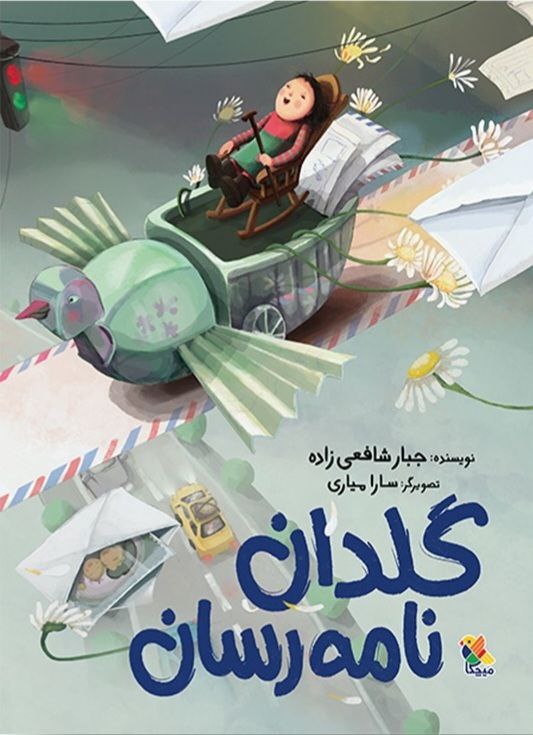
The Letter-Giving Vase, written by Jabbar Shafeizadeh, was printed and released by Mitchka Publications to educate children when facing the death of loved ones.
Referring to the publication of the book “The Vase of Letters” in Sanandaj, the Kurdish author of the children’s and adolescent books stated: “Questions such as what does death mean? Why do people die? Where does a person go when they die? What happens to a person when they die?” Can someone come back when they die? It has occupied the minds of all humans, especially children, wherever they are in the world.
According to the reportSpecialized Association for Children and MediaAccording to Ibna, Jabbar Shafeizadeh continued: “Although the content and purpose of children’s questions vary according to their age and the religious, cultural, and social context of the society they live in, the common thread among them all is the mystery and enigma of death.”
Stating that mythology, philosophy, religion, psychology, art, and literature have always tried to provide answers that are appropriate for the human mind to such questions, he added: Fiction is one of the categories that has managed to preserve literary characteristics while utilizing Using knowledge of philosophy, psychology, etc., to present the audience with an appropriate cognitive-emotional schema about death.
This capable and active author in the field of children’s books pointed out that “The Letter Carrier” as a children’s story, although it tells the story of death, is also a story of life, stating: “Ziko, the protagonist of the story, comes to terms with the true meaning of life through facing his grandmother’s death.” After his grandmother’s eternal journey, he sees his grandmother wherever he looks in the world and meets and talks with her in his imagination. The name Jikou, which means source and source of life in Kurdish, clearly indicates this.
Shafeizadeh stated: In “The Letter-Bearer’s Vase,” the two powerful instincts of life and death, in a Freudian reading, do not oppose each other, but rather proceed as two parallel lines until the end of the story, and each of them is revealed to the reader through letters with explicit content and Their hidden faces are confronted, they display their dominant side in the form of words and artistic images, so that the audience can choose between the two.
He added: From a semiotic perspective, in “The Letter-Bearing Vase,” the symbolic and semantic signs of death in Saussure’s system are transformed one after another into signs of life, leading to the creation of this central idea that death and life are intertwined in the scope of life. Humans are equally effective, although they have a specific, different, and unique function.
Shafeizadeh also said: “From Jung’s point of view, the vase in this story is a modern myth, which represents the archetype of the mother’s womb in a completely metaphorical and symbolic way, where every time a letter is placed inside it, the germ of a life is born.” He cultivates a new idea or a variant of it within himself and presents it to the world of fiction in the form of a new idea.
This Kurdish author, from the perspective of sociology, is a critique of the generally dominant structures and stereotypes in the book “Ishtar and Addu: The Letter-Bearing Vase,” which, in the form of a sad and mournful ceremony, attempts to diminish the subtleties of life, especially for children. Pure Silence, The black cloth, the picture frame hanging on the wall, etc., all as a result of the correspondence between Jikou and his mother, give way to joy, warm and bright colors, a small garden, etc., which the book illustrator cleverly uses in composition, contrast, tonality, and degree of The saturation of colors, as well as the difference in the type of lines and geometry of the volumes, depict this duality and fragmentation of space. Such an approach has enabled the book’s illustrator, Sara Miyari, to create images that originate from the child-centered imagination and imagination, while also telling a story. It narrates the outer, hidden, and inner layers of the story in an artistic way.
Shafeizadeh continued: “If we pay attention to the story in the book “The Letter-Bearing Vase,” as well as the letters that arrive from the grandmother and even the cake that is left in the refrigerator for Zhiko, we realize that all of them indicate the presence of the grandmother, of course with the help of Parents
He stated that the book “The Vase of Letters” begins with the absence of the grandmother at home, and reminded: “But as the story progresses, the presence of the grandmother becomes more prominent. In fact, this is a story that draws the reader to find the grandmother with him.” But In the end, like Jico, he realizes her presence by his side until he realizes where she has gone and what has happened. Although the intelligent reader soon realizes what happened to the grandmother.
He acknowledged: “The grandmother in this story is a symbol of life. She is a symbol of the garden and the greenery of the house. Although she is not there now, Zhiko continues her path and takes care of the garden. She digs it, puts fertilizer on the flowers, and in short, she does everything to ensure that the garden remains green.”
The author of the book, stating that the book “The Letter-Bearing Vase” is about life, even when our loved ones have left us, noted: “It is natural for a child who, from the very beginning of life, is careful about the environment and its factors that give rise to it, to become an effective and responsible person in the future.” He will be useful to his community, just as Zico took care of his home garden from the very beginning of his childhood, so in the future he will take care of the great garden of life and his community.