
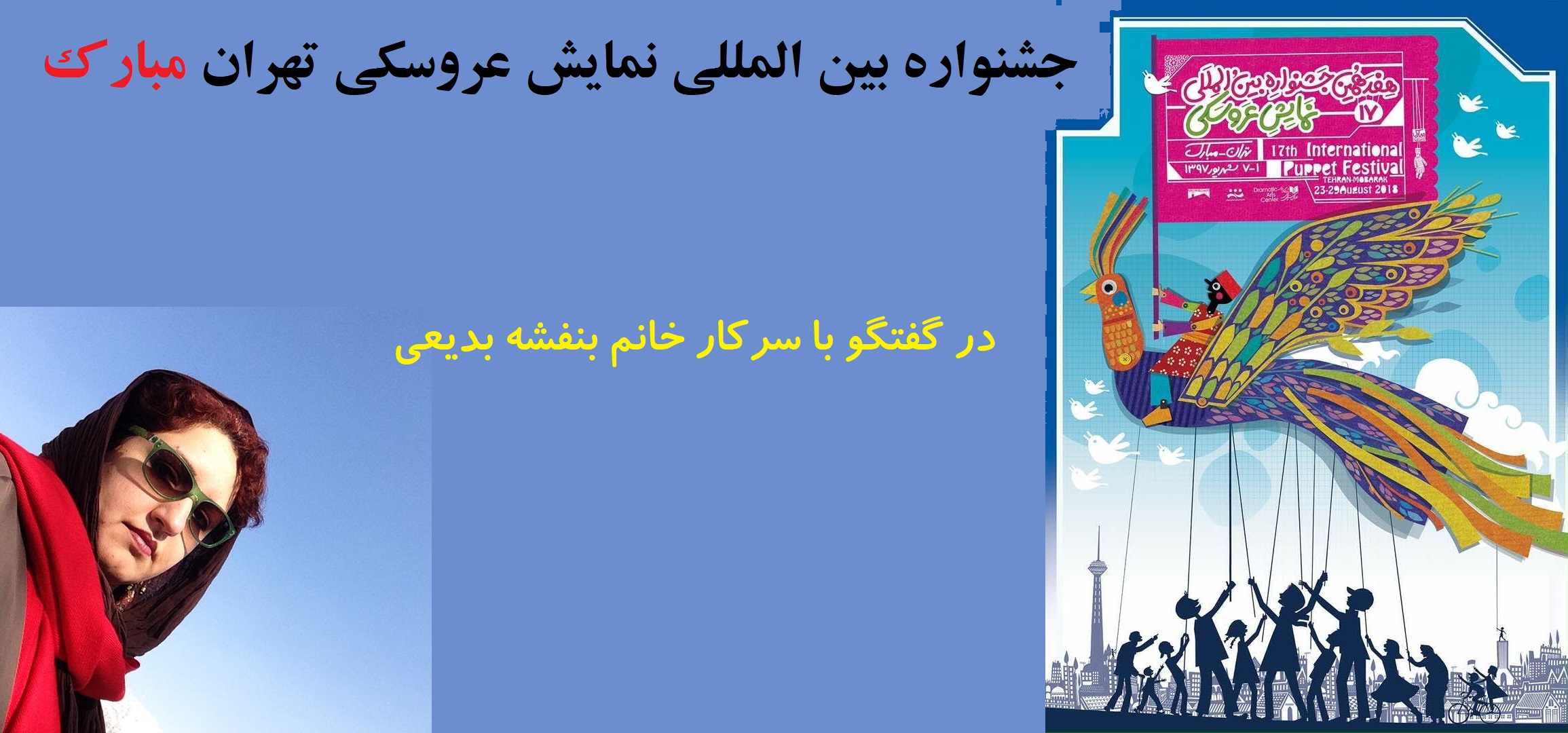
Biography

Banafsheh Badiei, born in 1977
Education: Theater degree with a major in puppet theater from the Cinema and Theater Faculty of the Art University.
Her main specialty is puppet making. After graduating, she focused on puppet making, especially puppet making for the screen, having created a large number of puppets for television, cinema, advertising, and theater, and she mostly engages in visual puppet making.
Puppeteers have to work in various fields, and puppet theater falls between the performing and visual arts. Therefore, she has a background in directing, voice acting, puppetry, photography, and so on.
Her other specialty is serving as an assistant planner in the directing team, and she has done a lot of administrative work. Currently, for three terms, she has been the assistant secretary or vice president of the Tehran Mobarak Festival.
She loves working with children and also has a record of teaching puppet-making to children and adults. After the festival, she is eager to focus on children’s production and programming, and alongside her concern for children, the environment and peace are matters of great importance to her.

1- Why was this name chosen for the festival?
The Tehran Mobarak Festival, because it is held in Tehran, and Mobarak is also the name of the main character of traditional Iranian puppet theater, namely Iranian traditional glove puppetry, whom we all know as Mobarak—for this reason, it is named Tehran Mobarak.

2- What is the reason for choosing the slogan “Blue Sky” for the festival?
The choice of this slogan has several aspects, one of which is addressing the importance of and caring for the environment, and on the other hand, addressing peace and the innocence of the world of puppets, which of course we can present in any form through our own imagination. The essence of the puppet world is a pure, unblemished, and clean world. And we hope that with this perspective, we can create more beauty in the real world with the help of puppets.

3- What are the stages of reviewing the plays?
From the collection of participating plays, we review and make the final selection, having received nearly 400 scripts in the first stage. And in the final stage, we have to accept 20 to 30 works, which is very difficult: reading scripts and viewing semi-ready works from which we must choose a few options. Many of our participants are also active in the visual field, such as Ms. Boroumand herself, who is the secretary of the festival and has directed and continues to direct visual television and cinema works involving puppet theater.

4- Who are the members of the review board?
The review board includes Ms. Maryam Saadat, Iraj Tahmasb, and Bahram Shahmohammadlou, all of whom are from the field of children’s and puppet theater in television and theater.

5- Which edition of the festival is taking place, and what is the reason for changing from annual to biennial?
The Tehran Mobarak Festival is the first international festival after the revolution and is very prestigious and well-known. The festival is holding its 17th edition. The early editions were held annually and afterwards it has been permanently held biennially. The reason for changing from annual to biennial goes back quite a long time; at that time, conditions were different, meaning the number of groups active in the field of puppet theater was limited, the number of productions was smaller, and the budget issue probably also played a role. All of these caused the festival to be held biennially, which worked for years, but nowadays, due to diverse and high-quality works, it is no longer sufficient. The festival belongs to the Dramatic Arts Center and is overseen by the Ministry of Culture and Guidance. They have scheduled other festivals throughout the year as well, and due to the existence of the Ritual-Traditional Festival and other festivals that are held biennially, in fact, reviving the annual format is no longer feasible at present. For three terms, Ms. Boroumand has been the secretary of the festival, and I also collaborate with her. A number of works—about 8 foreign works—are invited. Each edition is roughly like this, with a number of works from Tehran and others from other provinces, all of which run for a total of one week for performances.

6- What techniques accompany the dramatic works?
The works feature various techniques, including shadow, string, rod, glove, etc. Familiarity with these techniques will certainly be appealing to the group. I can provide explanations regarding this in one of your sessions. Puppet theater work is very different from producing a one-hour show; it might be possible to draw inspiration from it and identify its techniques, and usually, if a production is to branch out, it is very limited. Many of the forces currently active in television were identified through theater.

7- When and in what format is the opening ceremony?
August 22 is the opening, and this opening will take place in the form of a joyful parade or a quasi-carnival. People come with their puppets, and the groups also come with their performance puppets, and we cover a route with music and instruments until we reach the festival venue and hold the festival. Starting from September 1, plays are performed in various ways for six days, mostly at the City Theater complex, Honar Hall, or the Institute for the Intellectual Development of Children and Young Adults.

8- Does the festival include different and varied sections?
Yes, the statistical sections of the festival: the stage section, which is divided into children’s and adults’ sections, and the festival features different age categories, with a number of adult works and a number of works specifically for children being performed. In the international section, there might be one children’s work, and in total, we have six works in the international section. We have the collective section, the student section (produced by the students themselves), the street theater section, etc.

9- Could you mention the concerns of the festival?
One of the festival’s concerns is addressing the audience, and since Ms. Boroumand’s primary background is in television, she knows the audience very well and values them greatly. She understands audience tastes, and her works have always been enduring. She brings this same perspective to puppet theater and tries to engage groups by reconciling them with the audience. Previously, performance style leaned towards a niche audience, but with Ms. Boroumand’s presence, the perspective became more serious, and the plays were able to establish a good relationship with the audience, achieving greater and better quality, and they have been very successful.
کارناوال شادی بزرگترین طراح و سازنده عروسکهای تن پوش تبلیغاتی در ایران http://WWW.toyir.ir
http://www.carnavalshadi.com
http://www.09121225063.com
http://instagram.com/aroosaksaz_shahram_shajari