
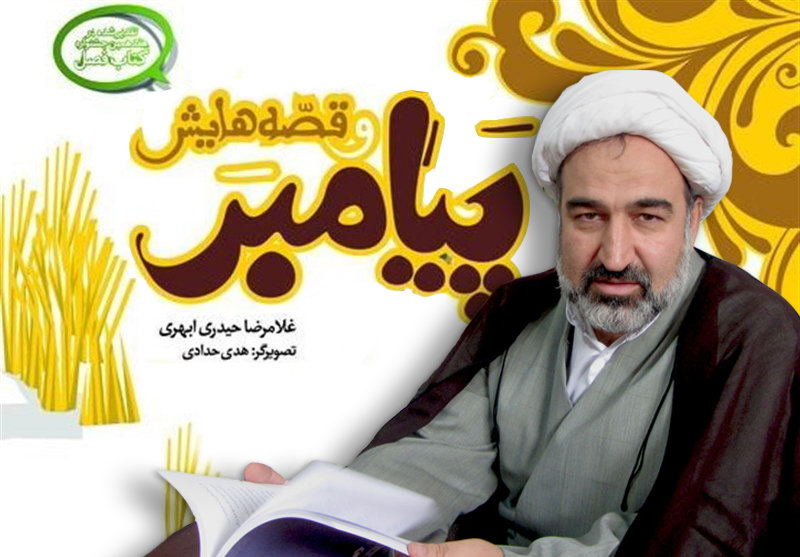
Master Introduction
Gholamreza Heidari Abhari
He was born on the first day of Farvardin in the year 1348 in Tehran. He is a writer and researcher in the field of children’s education.
Among Mr. Heidari’s works, we can mention:
Quranic Theology for Children
Quran Encyclopedia
Bread and Salt, etc.
Some of his works have been translated into English, Arabic, Urdu, Madai, and Spanish.
His books have been selected in several national festivals.
Greetings and respect to you
In your opinion, what characteristics should a capable children’s poet and writer possess?
In relation to children, the most important indicator is entering the mysterious world of kids.
We must be able to discover things so that our children can better connect with them.
Merely applying the rules of writing and being a good writer is not enough, rather connection is the best element for writing.
If we consider the world of children to be one hundred percent, a fifty percent connection is not good at all. A children’s writer must bring their connection to its peak by discovering the child’s interests.
What suggestions do you have for improving children’s writings?
In the future, you will see that writings dedicated to children will be full of complex issues. Because our children, from the past until now, have become smarter and their thoughts more complex due to technological advancements.
Writing for children is only one part; we must be able to express the complex issues of our children in simple and beautiful language in our writings, and this requires research and investigation.
It is not possible to write a story without research on a specific topic. For example, for the topic of anger, if the writer has not read a few children’s psychology books in this field or has not researched, how can they express it well in the story?

What is your writing style for children?
Expressing religious issues for kids relying on language that is understandable to them. Like the book “God, May I?”. I used to collect children’s questions about God and answer them in a childlike and understandable way. This book won the Intellectual Development Center award. And also the Islamic Republic’s Book of the Year 1395 award. I tried to write according to the needs of today’s children who deal with technology.
What is the difference between book texts and television program texts? And what rules and principles should writers pay attention to when writing television texts?
When we talk about a television program for children, we have three topics:
The program text, television, and the child.
Each has its own rule. Television: television rules. Child: issues related to the child, and text: must be aligned with their mind, needs, and interests. When we say mind, it means the child’s comprehension ability. Language and vocabulary must be within the circle of their interests.

Basically, what is the difference between dramaturgy and storytelling for different age groups of children, and where do writers get these principles and rules?
The most important issue is that someone who writes for kids should understand them and know the extent of their capacity.
Without this understanding, a writer cannot be a good writer. One must recognize the conditions and characteristics of each age group.
Among the issues that a writer must pay attention to is expertise. A writer must have previously acquired the necessary expertise in the field they want to write about. For example, a writer who writes about Sohrab for children must have previously studied several historical books in this very field. And similarly in other fields.
Due to the increase in people’s information, children’s literature and writing must also be specialized.
Just as the expertise of every doctor is clear, in children’s literature too, every individual should have previously acquired the necessary expertise regarding their writings and should not write without research and study on a specific topic.
Thank you for the time you provided us.
Be proud and victorious.
لطفاً تلفن تماس انجمن را می خواستم
۰۹۳۶۴۰۷۵۸۴۰