
Abstract:
Reviewing ” How to Train Your Dragon “, which has been dubbed as Dragon Trainer in Iran, is one of the important films in the field of children and changing wrong thinking or combating superstitions. The plot of the film is a retelling of an old story about dragons, which can be a suitable experience for filmmakers and writers based on folklore tales; a story about dragon attacks and changing the perspective on considering them as enemies. It is worth noting that in some aspects, this film is also very remarkable, such as the issue of soft war and similar subjects, but given the publication’s approach of examining the topic from the perspective of storytelling for children, we will not address this section and will only review the parts related to children.
Although the premise of this story could have been designed in the horror genre, it is engineered in such a way that after the story ends, not only are children not afraid of dragons, but they even wish to have a dragon of their own, and perhaps some parents might be forced to get a real dragon for their children. This subject and the engineered finding of the message in storytelling can be of great interest to native storytellers in Iran, because unfortunately, in most Iranian works, we realize that the storytelling of demons, etc., has had a very bad effect on the psychology of children, and the reports presented by psychological consultants in this regard have reached a dangerous threshold regarding the style of Iranian storytelling. Paying attention to this important point in the story of How to Train Your Dragon and the way dragons are encountered in this work is a very suitable model for illustrating works with components that can walk on the edge of a child’s fear or a child’s love for a character.

Film Plot:
The story of the film is about a barren land whose people have destructive enemies that attack and loot the village every once in a while, until one of the village children, who tries to prove himself to his father, accidentally hunts a dragon that he cannot bring himself to kill. Along the way, he realizes that the belief about dragons being enemies can be revised, but this perspective brings opposition from the elders and drives the story forward. It is worth noting that a series based on this film has also been produced and has a good audience.

Detailed Story and Story Analysis:
Father-son relationships are one of the most important raw materials for storytelling. In these types of stories, the father has a deep affection for his son, yet cannot rely on him, while the son strives to prove himself and his abilities to his father. How this happens can diversify the stories. The narrative of How to Train Your Dragon is the story of a very skinny and frail boy living in a village of very sturdy people—a village of Vikings who, according to the narrator of the story (who is the boy himself), neither grow fruits nor have easy living conditions because of the cold. It snows almost all year round, and it hails for three months (although this part is not seen in the film, even though it says the story begins in this barren land whose only source of income is a bunch of sheep and the fish they catch from the sea).

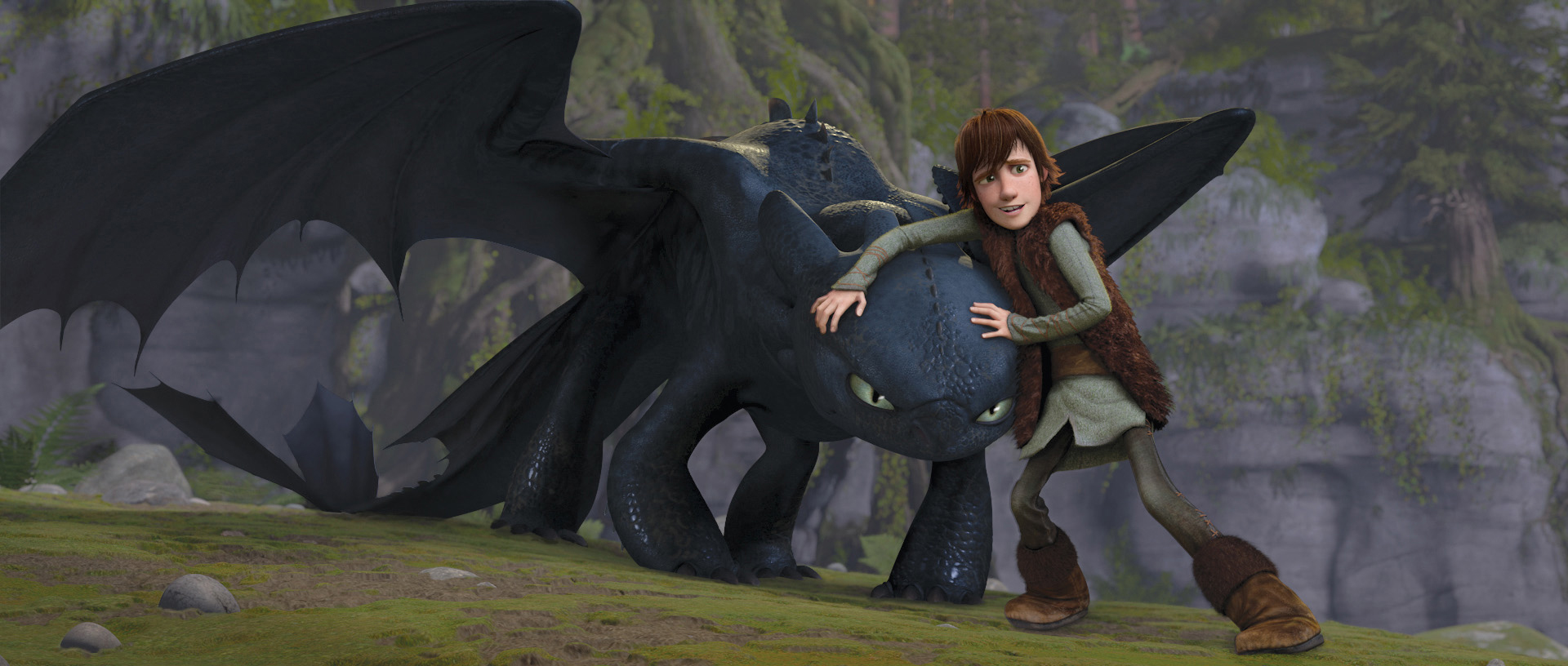
In this village live Vikings with a history dating back 300 years, but the village has a strange problem: the attack of dragons that loot the village without coordination or warning. Because they breathe fire, when driven away, they leave behind a burned village. Now, while everyone in the village is preoccupied with destroying dragons, our story’s boy accidentally fires a shot in the dark using a special weapon. Although this causes heavy damage, no one believes that his shot has hit the most important and dangerous dragon in Viking history, which no one has managed to hunt yet. The next day, the boy finds the wounded dragon and decides to take its heart to his father to prove himself, but upon looking at the dragon’s innocent face, he feels pity and realizes he is not capable of such a deed. In this encounter, the dragon, whose tail is injured, cannot escape the ravine where it is trapped. The boy helps the dragon by designing an artificial tail, and now they become good friends. Encountering the dragon, the boy discovers the secrets of managing and guiding dragons. By empirically observing phenomena around him and their effect on dragons, he becomes a dragon trainer. When the parents of the children launch an army to find the dragons’ hiding place and the children must learn the secrets of dragon slaying, the boy brilliantly displays his power in taming dragons.

Eventually, a village girl discovers the relationship between the boy and the dragon and decides to expose it, but the boy tries to explain to the girl that his dragon is harmless. As it happens, both of them and the dragon get drawn into a dangerous adventure. All the dragons that loot the villages take their plunder to a giant dragon, who seems to be the slave-master of the dragons. The next day, the boy is honored for his abilities by being allowed to kill a dragon, but on the day of the celebration, the boy tells the villagers that there is no need to consider dragons as enemies. The villagers refuse to accept his words and, with his dragon captured, march towards the dragon queen. However, at the moment they are losing to the queen dragon, the boy, accompanied by the village children and trained dragons, comes to the parents’ rescue. When his father realizes his mistake, the boy, with his dragon’s help, kills the queen dragon, though he loses his foot in the process. Along the way, the children realize that there are perhaps twenty to thirty types of dragons.

Strengths:
- The main story of the film is about a child who does not have proper physical abilities—meaning that in a village where everyone’s duty, even the women’s, is to kill dragons, he cannot even lift a sword. Yet, using his mind, engineering, and utilizing tools or dragons to achieve his goals, he saves the villagers. Paying attention and care to a child’s abilities and not blaming the child for their god-given creation in this encounter is portrayed excellently.
When physical strength was more important, the best husbands and the best individuals of the tribe were those with superior physical strength, as it was clear they could save the tribe and continue the lineage. But now, when physical strength is not as crucial, intelligence, thought, and creativity matter, and in this same group, this boy is noticed when he can demonstrate his capability in taming and dealing with dragons. Part of the narrative also repairs the father-son relationship, suggesting that children should be raised according to their own times—meaning perhaps there are things they understand that mothers and fathers do not. - This film is one of the suitable movies for repairing the father-son relationship, and perhaps its counterpart, Brave, strives to repair the mother-daughter relationship. Initially, right up to the scene where the boy is mounting his dragon to attack the dragon queen, the moment of repairing the father-son relationship is triggered. With a tone tinged with pride in having such a son, the father asks him that if he doesn’t want to, he doesn’t have to participate in the final attack. But the boy tells his father with authority that we men are authoritative, and when the father apologizes and sends him off to the attack—which takes place like an aerial squadron—this apology gives the boy a huge boost of energy. The attention paid to this type of dialogue is a suitable model for the evolution of the father and repairing the father-son relationship.
- This story can also be considered a story in the realm of transformation; a boy whose father’s main concern is that he not be hunted by dragons. The story suggests that there is no need to emphasize what society dictates; by careful observation, correct use of innate nature, and a proper view of your surroundings, you can best reform the transformation of society, the perspective on individuals, and relationships with friends and relatives, and even become the savior of society with this outlook.
- In the field of upbringing and education, the story also has something to say, pointing to parental anxieties. The boy lives in an environment where physical strength is the most important component for survival. The father is worried, knowing the boy cannot handle dragons, and his concern is that dragons will eat his son. Ultimately, however, it is the boy’s precision and intelligence that save society, not physical strength. Acknowledging that every individual has their own capacity is an important point in upbringing.
- The storytelling of the film also leans towards escaping conventional education—education devoid of a basis in whether it aligns with reality or not. Practicing on captive dragons, which has been customary in the film’s society for three centuries, if directed toward realism, can solve society’s problems. What the boy has learned stems from a context almost unrelated to the predetermined educational equations of the Viking educational system; what he learns and develops happens in the reality of the external world, not in a laboratory environment or with society’s superstitious presuppositions.
- As you know, storytelling and screenplay engineering in Hollywood are somewhat inspired by music. For example, when you listen to music, a rhythm starts first. When your mind gets used to this rhythm and, according to mental psychology laws, the mind does not want this flow to be interrupted, the musician adds a second rhythm to the first to disrupt the mental space. These two—continuing the first rhythm and adding the second—while arousing and creating anxiety, somehow heighten the person’s focus on the music. This process with the third, fourth, and subsequent rhythms makes your mind more alert and increases your attention to the desired music. As it becomes more exciting, these consecutive rhythms break the state of inertia the brain seeks and increase concentration on the melody. This exact experience is applied in screenwriting as well; meaning in the course of the story, the viewer moves from point A to point B, then in the middle of this story arc—usually spanning at least 5 to 10 minutes—just like the second rhythm of music, a second story suddenly begins, and similarly a third story, and so on. If we follow this in the story, in the first part, the boy narrator explains his village’s situation to you. While you and your mind are aligned with this story, suddenly the second story begins within the first: the village is attacked by dragons. At this point, the third story starts: the boy fires the catapult toward where he thinks the dragon is, and everyone in the village blames him. In the next story, within the next five minutes, he finds a dragon in the forest, and the story continues. In other animations as well, this pattern is followed, which can be appropriately segmented, and through reverse engineering, one can arrive at a proper approach to the story. Of course, it is completely clear that the overall work also has a comprehensive approach: the story of a clumsy boy who saves the villagers with his capability and intelligence.

- This story seems to have a main narrative. Regarding this main narrative, there is a psychological rule that you are afraid of something, but you are wrong; even the English title is How to Train Your Dragon. Inside you, there is a dragon; you can make yourself and society safe by training this dragon. This dragon can be anger, jealousy, and all the traits that manifest dangerously in society today. You can train the dragon of your anger in such a way that not only does it not cause destruction, but you can also go to the aid of the oppressed. Furthermore, a person who has the ability to tame their dragon can complement each other, and at the same time, others, inspired by this experience, can train their dragons well too. This mutual evolution causes their friends to progress altogether—meaning they both employ them and, by using this service, feed them and fulfill their needs. A positive aspect of this is overcoming fear, which ultimately makes the child understand that if you overcome fear, you reach victory and success. Until you believe in yourself, victory is not on your path. Another point is that all flaws are curable; at times, these exact flaws become stepping stones, just like the boy’s arm and leg when paired together complement each other.
- The second point is that this film is very beautiful in terms of psychological education—meaning suppose that in the subject of children’s fear, anxiety, or many other topics, this film can prepare a ground for us to convey certain concepts to the child in accordance with the story’s content. If this film is used to teach the child in a controlled manner… one of the problems parents have with their children is communicating with them, and knowing where the spark of communication should be ignited and on what basis or context I should present my words to my child is very important. Smart parents can watch this film together, and later when the child struggles or doesn’t struggle with something, they can open a dialogue and use those sequences from the film.
- Another topic is moral intelligence. We have several types of intelligence; the intelligence that currently exists is general intelligence or IQ. No one disputes IQ anymore, but emotional intelligence is still debated, and we have spiritual intelligence. There is also a topic recently addressed: how we can enhance a child’s moral intelligence. One of the topics raised in moral intelligence is kindness. A mistake families make is thinking that simply telling a child to be kind solves it; kindness in a child requires upbringing and training. This film somehow gives me the message that if you want to teach your child kindness, for example, you must instruct them, and this film shows what methods you can use, what benefits kindness has, and how you can be kind. For instance, when we want to establish a relationship with someone, we should try to figure out their weak spots and see what they are sensitive to. This film has a very beautiful message: from the beginning to the end of the story, you see that no change occurs in the child—meaning the child is clumsy from the very beginning and is still clumsy at the end, meaning the girl is still the dominant force. But it says within your current domain, with your exact character persona without bothering yourself too much, how you can create a fresh perspective and behavior in yourself. This boy undergoes no personality change, but he exhibits certain behaviors that can make him prominent in his society.
- Regarding this dragon, there is a point that the creators tried to keep the context genuinely child-friendly; it didn’t utter a lot of useless and redundant talk, didn’t add extra philosophical terms, and didn’t raise many structures meant for adults. It stated a point very simply and easily without complicating it too much. One of the elements I say a children’s film must have is ease—meaning the child should understand it very easily and be able to grasp its story without it being overly complicated with thousands of philosophical concepts and the like.
- There is an anxiety that becomes pathological and harmful, and sometimes it is not like that. Now imagine that in this very matter of dragons, after all, the child has never seen a dragon in their life, so it is quite appropriate. But if it used an issue like a jinni, it would become extremely dangerous. For example, in schools, the topic of jinn is frequently discussed; when you go into treating it, it is very complicated. Now, with the myths that individuals and Hollywood construct, jinn and fairies are phenomena that emerged from the 1980s onward—before that, The Exorcist came out, and they started this process to frighten people. An example was the documentary-style film from a year or two ago, or another example like The Blair Witch Project. There are various examples that try to frighten children and adults with jinis. The jinn-phobia project aligns with freemasonry.
- For instance, first of all, we have a topic in psychology where simply witnessing violence causes a person’s hidden violence to be satisfied in some way. The issue of weapons sometimes becomes such that the person no longer seeks out weapons. It is not necessarily true that the more violence we witness, the more violent we become.

Weaknesses:
- A very important issue in this work is the film’s portrayal of girls and boys. In this film, Astrid, who plays the girl’s role, despite having a very feminine physique, exhibits very violent and masculine behavior and is perhaps even more manly than the boy in the film. There is a girl in this ensemble who has stepped out of her feminine nature and turned into a warrior. From our perspective, this is not a suitable viewpoint and indicates a feminist perspective—the equality of men and women, in fact, underlies this plot and agenda.
- The use of violent tools such as axes, swords, and hammers at the beginning of the animation, which starts with a dragon attack, and ends with the depiction of a battle with dragons at the end. In between, there are constant attacks they launch on the village. It starts well, but they constantly show knives, plunging daggers into bodies, and all of this displays violence, teaching the child to go straight into that constructed room and fight the dragon. It continuously transmits violence.
- Another issue is learning-in-action, where children are thrown into the heart of dragons to confront them themselves, fight them, and defeat them. I think the core message being conveyed is that a human being can overcome anything and conquer anything with their abilities—sometimes using brute force, sometimes using affection, and sometimes using intellect. Here, it is insinuated more that while muscle and force work to protect yourself, in many places the power of affection triumphs over muscle and force. In fact, the boy’s goal in hunting the dragon becomes a superficial and individualistic goal; the boy wants to go hunt the dragon not to save his people, not to escape the predicament everyone is trapped in, but to win the attention of a girl.
- Another negative point was the bickering between the boy and girl in this program. Of course, given that at the end of the work all this bickering turns into a kind of empathy and cooperation to overcome the problem, this negative point is somewhat downplayed. However, considering that in most cases children learn the wrong behavior, the issue is that you present a negative point, then patch things up later in the story to arrive at a good outcome—for instance, saying at first “do this” (meaning the story’s characters are doing this), and when we move forward, we say “see, I did this and got hurt.” A clear example of this was the series Red Line. In this series, it showed several young people running away from home to go north, constantly having fun there, and suddenly—just to show that this is a bad thing—the car they stole happens to contain drugs, and then one of them catches AIDS and runs into trouble, and so on. But the message conveyed is: at the first opportunity, make a plan with your friends and run away, then you’ll have a blast; just make sure not to steal a car, but if you do and it has drugs in it, hand them over quickly so you don’t get caught. That is, the direct and impactful insinuation means: run away. In pathology, when a wrong point is stated followed by the correct solution, it has been proven for various reasons that children and even adults are more influenced by the wrong action.

- The relationship between the girl and the boy is erotic in stages.
- The next topic is abuse. In European and American countries, we heavily deal with the issue of abuse, one of which is sexual abuse, which severely threatens the West and often comes from immediate relatives and family members like daddy and mommy. When a child watches this film, somehow a sense of carelessness, lack of fear, and lack of caution is promoted—that whoever your counterpart is, no matter how terrifying their face looks, you can approach them with kindness. Especially for girls, telling them not to be afraid of someone with an ugly face if you are kind to them, they won’t harm you—this is completely wrong. Someone might intend to abuse and will carry out their abuse whether you are kind to them or not. This is one of the hidden harms of this matter. How many scenarios do we have in children’s and teenagers’ stories where if someone tells you, “Come, let me give you an ice cream,” you should say, “I’ve already eaten ice cream, and if I want any, I’ll go buy it myself or my dad will buy it, you don’t need to buy it.” Given the harms children have faced, many films are produced regarding distrust.
When you tell a child that if they go to the park, there are addicts there who will come and steal children’s kidneys, it shouldn’t be expressed with such intensity that the child develops a sense of fear and anxiety that society is an unsafe environment where everyone wants to kidnap you or abuse you. Not to that extreme, but teaching that if a dragon appears in front of you, you just tickle it and the issue is resolved—that is flawed. - Another issue we have here, which must be very carefully considered in Iran, is that we always instill in our children either to become a doctor or a pilot. This film is also somewhat a pilot training—well, not training, but an encouragement to become a pilot; it greatly stimulates children’s sensation of sky-wandering and flying in the skies, evoking the excitement of flight like nothing else, and this is very harmful.
- The difference between The 29th Night and current horror films is that The 29th Night says: this alley you are seeing in the film is your very own alley, that woman you are seeing is your neighbor, and that man you are seeing is yourself. It is so close to your living space that it strikes fear deep into your core.
- Overall, Western civilization is a tragic civilization. This is a very broad topic: the entire philosophy and history of Western civilization have a tragic outlook. For example, their symbol is the cowboy—a lonely person abandoned in a desert with only a few cacti. All Western symbols boil down to solitude, where you must always make peace with your loneliness.

Suggestions:
- Suppose we want to make an animation that is the Iranianized version of this animation. It seems we must first define a behavioral goal: what is the dragon for an Iranian child? For example, if we want to delve into behavioral goals, perhaps in our minds we might say that in this society I cannot achieve a successful marriage without having a girlfriend. We define a behavioral goal in an animation where a boy, for instance, realizing that one cannot get anywhere without a relationship with the opposite sex, ultimately succeeds; or for example, addressing how marriage is currently unaffordable in our society due to heavy expenses, the dragon becomes these heavy marriage costs. We show a child who plans from childhood, overcomes the dragon of fear of marriage, and achieves a successful marriage. Or suppose in more general topics, currently in our society regarding children, there is the issue of injections. You know, when you want to remove a child’s anxiety about getting shots or visiting the dentist, psychologists suffer terribly—a psychologist goes through hell and back. We can take this exact dentist issue where a child has a dental phobia, their dragon is dentistry, and in a 130-minute animation, this character reconciles with dentistry and overcomes it. For example, we could portray the Konkur exam as a dragon; or to make it religious, if we want to become someone who can see the Imam of Time (Mahdi), since that is an unattainable thing, let’s say we cannot see the Imam of Time. Let’s consider a child who is afraid of their grandfather’s ghost; the child loved the grandfather and was very attached to him, the grandfather dies, and the child experiences extreme anxiety. Through a series of stages, the grandfather appears in the child’s dreams as a ghost.
- A few points came to my mind: one is that I think when we want to use the element of fear or any other element—especially when it takes on a fictional form—if a proportional reduction is established between that fictional element and one of the realities of life… showing the dragon from start to finish, while it had certain merits and good effects, because the dragon was entirely unbound and had no connection to our external and real life, it produced certain consequences which I will explain. However, I think if a proportional reduction is established between that element of fiction and the element of capability, its effect might be better than merely showing a dragon from start to finish. While this message was conveyed, if that other thing had happened, it might have been more appropriate—starting with a fictional dragon but then connecting it to a real element that can relate to our lives. When I first saw this film and saw the dragon, the first thing that came to my mind was Rumi’s poetry; perhaps that could be worked on. The reason is that they have certain concepts, while we have entirely different concepts in our discourse. For example, the best thing that facilitated the introduction of Shia Islam into Spanish-speaking regions was the translation of Sahifa Sajjadiyya; none of the theological debates our clerics engage in to silence anger have ever been used by Shias for this purpose. Sahifa Sajjadiyya and Masnavi Manavi were translated, and people thought, “they think so grandly.” The animation you saw has actually adapted one of the stories of Masnavi Manavi, executed it with great subtlety, and taken it to Austria where it won first place.

- The point here is that except for this child, everyone else wants to kill the dragon and is out to slay it, while the child brings the dragon under his control. This reminded me of the concept of combating the carnal self (Nafs), where they say you don’t need to kill the self; rather, you bring it under control, direct it, and place it within frameworks. Therefore, perhaps this can also be connected in some way. Overall, I think starting with a dragon and connecting it to a real person would be better. At the same time, my opinion is that while the dragon being free-roaming wasn’t tied to anything concrete, it carried several very important messages that are missing from our programs: one is the necessity of struggling in life, as some of the things his father said placed the child in an environment where he learned to struggle—serving as an educational message for parents while teaching the necessity of struggle. On the other hand, it touches upon the importance of power, because power is effective in our society today, while also telling the child that here what matters is your ability to handle the dragon, yet power remains important in society. Another point is having different solutions for a problem; everyone else wanted to kill the dragon, but he said we have another solution: control and bringing it under control. Another point was that we do not always need to solve problems with a cold war; sometimes we lean toward soft war.
- It’s not soft war, but it says we cannot do it with physical strength. With soft power—we don’t always need to operate using hard power. As for the topic of violence—well, you can’t quite call it violence, we need to find another name for it. After all, in our religious foundations, we are not supposed to be overly pasteurized either. They say if you go to Hajj and are able to slaughter the sheep yourself, slaughter it yourself, or in other rulings where there is currently disagreement and scholars differ, such as Qame-zany (head-striking mourning ritual), yet I’ve seen in some jurisprudential foundations that there is a aspect where a human’s fear of God is dispelled. The question of how much violence and fear matter in religious foundations is a project, and we must work on what can be extracted from these foundations. Truly, no one has worked on these subjects yet.
Authors:
1. Fatemeh Ramezani
2. Mahmoud Alipour
3. Dr. Nasir Abedini
4. Ehsan Shariati
پیشنهاد می کنم راجع به برند سازی در برنامه های کودک هم تحلیل بگذارید