
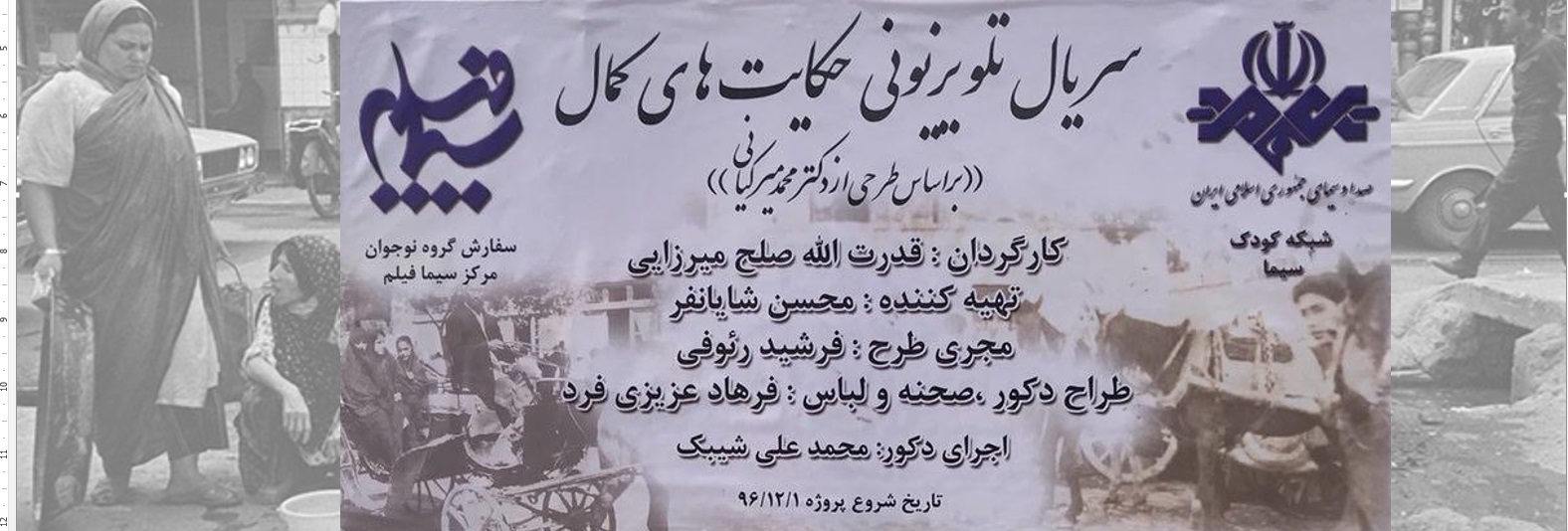
On the occasion of the making of the longest children and young people series in Iran based on his book “The Tales of Kamal”

📽Please introduce yourself?

I am Mohammad Mirkiani, a children and young people writer. For nearly 37 years, I have been writing officially for this age group and working in various fields. In this arena, I have held diverse cultural management positions; from IRIB and radio to Saba Center, the Institute for the Intellectual Development of Children and Young Adults (Kanoon), and children and young people’s press. Also, children’s groups of Channel 1, Channel 2, and Jam-e Jam, membership in the Farabi Cultural Council and the Council of Authors of Educational Textbooks of the Ministry of Education. The works published by me include 80 books, and with the works published this year, it amounts to more than 700 stories, most of which are dramatic collections.
I have won the Book of the Year award three times, and some of my collected works have been published in Turkey, the Republic of Azerbaijan, Turkmenistan, Tajikistan, as well as scattered works of mine in Russia and India. In 1999, the International Youth Library in Germany included my books “Paper” and “Once Upon a Time” in its list of suitable books. I have also been commended in various domestic festivals, such as the 22nd Hamedan International Children’s Film Festival, the Kanoon Storytelling Festival, and storytelling for mothers. I have occasionally been commended and won awards from various centers and am still engaged in research and writing in the field of children and young people’s literature. The subject matter of my works spans various genres, from realistic stories to fantasy and humor, as well as works of ancient literature, new atmospheres, and comedic settings. I have also studied in various fields such as ancient literature, Iranian literature, and the history of Islam.
During this time, over various years, I have been engaged in designing radio and television programs. In radio, from ’60 to ’71 [Solar Hijri], I was the chief editor of Friday Noon Stories. I designed some radio programs, such as the program From the Land of Light, and have designed and served as chief editor for some other programs such as Spoken and Unspoken of television children’s groups like Good Afternoon Kids, Good Night Kids.
I have also taught at Kanoon, the university and faculty of IRIB, and the Ministry of Education. So far, more than 200 of my stories have been adapted into animation works, and I have written more than 200 short and long radio plays for kids, along with scattered works for adults.
I have been a judge at Kanoon festivals, radio and television program festivals, and am currently responsible for the screenplay section of the Television Animation Festival, and have also been a judge at the International Children and Young People Festival.
I have also been a member of various councils, such as the IRIB Plan and Program Council, the Television Department, Saba Center, and currently, I am the head of the Children and Young People Commission in Provincial Affairs.
📽Please provide some explanations about the new series being produced based on your book “The Tales of Kamal”?

“The Tales of Kamal” is a 150-episode series that will be produced in 5 parts, the first part of which will be 31 episodes. If God willing, with the endeavor of IRIB, all 150 episodes are produced, this large collection will be the largest story collection in the history of the national media for the children and young people audience. The atmosphere of this collection is the atmosphere of old Tehran in the 1940s, which encompasses untold aspects of our Iranian-Islamic lifestyle and traditional national and religious customs. Above all, it will lead to a better understanding of today’s life by children and young people. And if today’s children and young people know what difficulties the children of the 1940s grappled with and what hardships they endured in life, they will greatly appreciate their modern life, and many children will know that the 1960s was a heavenly decade in Iran, contrary to what everyone says that the 1960s was a decade of deprivation.

📽What has been your approach in this series?
It is very important to me that children appreciate their lives and know what hardships and difficulties those born in previous decades in this country grappled with, and with what poverty and misery their fathers and mothers lived. It is true that our people are a patient and forbearing people, but we must accept that this life and great nobility cost them dearly and they had many untold bitternesses.
In fact, the work we do in the content of “The Tales of Kamal” is broadening the vision of children and young people regarding the concepts of life, without concealment, sloganeering, or giving unreal statistics, and based on real historical documents in the form of a visual work for children, this work will be produced.

📽Will this approach and narration of bitternesses not cause audience fatigue, and what measure have you devised for it?
Of course, this atmosphere is a joyful one, and so that children do not become depressed and bitter, it is narrated in a comedic and joyful way, and amidst these joys, the bitternesses and hardships of life are also narrated.
Life is just like this, and even in dark images and the hardships of life, there is laughter, albeit bitter laughter. And our effort has been to create a joyful atmosphere in this setting so that children laugh.
The life of kids is also like this, and while they get acquainted with hardships, these hardships are conveyed to them in a humorous language, which causes children to be happy, smile, and learn, and this is a point that we insist on very much.

📽What stage is the work in now?
Fortunately, we have passed the pre-production stage, performed makeup tests, and are currently building the neighborhoods and parts of the neighborhoods of 1940s Tehran, and God willing, filming will begin soon.

📽Where is the filming location located?
Part of the location is the construction of the bazaar in Ghazali Cinema Town, which is Kamal’s neighborhood. Another part of the location is an elementary school where the story of Kamal takes place, located with the presence of 100 children in one of the old schools in the neighborhoods of Tehran, which is very close to that old atmosphere. Other locations include some old alleys and neighborhoods of Tehran.

📽Are children the only audience for this work?
An effort has been made for this work to have a dual audience, meaning all kids see this work as well as adults, and both enjoy this collection, and of course, the memories of the adults are also evoked. This will cause children to ask their parents about past memories, and parents will also try to recount their past memories.

📽Can it be said in a way that this story happened during your childhood?
Yes, my memories are from that era, but not 100 percent; rather, they are reconstructed memories. Our intention has been that parents and children, beside the tablecloth, during travel, and anywhere they are reminded of this series, a dialogue opens among family members and relationships between children and parents come alive, and this storytelling by elders, by recalling the past and telling it, creates an intimate atmosphere in the family environment.

📽Do you also use the games, songs, melodies, and music of that era?
Local games like Alak-Doulak, Haft-Sang, and Panj-Sang are used, and some ballads and songs of that time that have a moral foundation and basis from that era will be used. In fact, an effort will be made to bring the audience closer to those days to increase the level of credibility of the work for the audience.

📽Will you directly refer to the beginning of the formation of the revolution in the 1940s as well?
Not in a serious way, but it will be addressed generally. Because the 1940s was a decade of specific modernization, and the regime embarked on modernization, and it was in the 1940s that SAVAK was established, and a significant portion of farmers were displaced from their land and homes, and marginalization expanded greatly in Iran. Families were migrating from villages and were displaced under the pressure of the gendarmerie of that time. The atmosphere in which Kamal’s story takes place was one of the suburbs of southern Tehran.
And at that time, Tehran was a limited city, and it had been announced that if people built houses outside this boundary, it would be termed “out-of-bounds,” and water, electricity, and urban facilities were not provided in out-of-bounds areas. In fact, Kamal’s story starts from there. From water reservoirs at a time when people brought water from water reservoirs in the early 1940s, and the lack of electricity. In Tehran, there was an electricity plant called the Edison Electric Plant.

Generally, there were 4 electricity plants in Tehran, one of which was located in southeastern Tehran called the Edison Electric Plant, which was a private electricity company, and there were other electricity plants in Tehran’s Cheragh Bargh and Cheragh Gas. In the early 1940s, that region did not even have Edison electricity yet. Of course, that plant currently exists and is the Iran Electricity Museum, located in southeastern Tehran at the present-day Khorasan Square (or Tir-e Doqolou Three-Way Intersection), where part of Kamal’s stories takes place, spending some time there without water and electricity. At a time when the Mirab (water distributor) came and flowed water into the streams, and people drew water from the water reservoirs, pumping water from the reservoirs to extract it.

Those who wanted drinking water brought water from various places, for example, bringing water using water-carts (Feshari). One of the jobs at that time was selling water in barrels. In the southern region of Tehran, water was brought and sold with such difficulty. And that atmosphere is the atmosphere that is depicted for children so they realize with what life difficulties they lived in that era.
Women washed clothes in water streams and even washed carpets in the streets. Of course, Zilu (cotton rugs), not carpets, as few people had carpets, which they washed with water-carts, and women tied chadors around their waists and washed carpets with toil and difficulty, and the atmosphere was like this at that time.
Of course, later when reforms happened in the late 1940s and early 1950s, that too did not last long because a set of wrong economic decisions and the economic dependence of the monarchical regime on foreign countries plundered the country’s resources, and the regime did not do the things and collections it should have done for mother industries, so the scope caught up with the nation. Even though we had an increase in oil revenue in those years, we faced frequent power outages. Of course, the story does not stretch that far, and my point is that the atmosphere was like this and practically everything of ours was dependent, and the heavy expenses of the monarchical system cured no pain and had greatly expanded marginalization. For example, neighborhoods like Darvazeh Ghar, Dowlatabad, or Halabiabad, around Tehran in ’56 [Solar Hijri] there were many such neighborhoods, around Tehran was full of brick kiln factories and destitute and impoverished people worked in them.

And Tehran was a completely backward city. Even until ’58 [Solar Hijri], we had fruit sellers and peddlers who sold fruits in the market using pack animals, and Tehran was very backward, and even until ’50 [Solar Hijri] we did not have a sewage system. If someone registered for a telephone, it took fourteen, fifteen years for them to get a phone, and this relates to ’59 and ’60 [Solar Hijri] as well, because infrastructural work had not been done, and only one neighborhood in Tehran had piped gas, and old double-decker buses maneuvered all over Tehran, except for some areas in the north of Tehran, and Tehran was truly divided into two completely north-city and south-city regions.

The 1950s was a bitterer period, and the double-decker buses commuting in the south of the city were such that passengers hung from those buses and public transport was so scarce. The current generation does not know these things, and the elders also hide them, and we give false information to our children and expect correct decisions to be made based on it.

📽Will this be a political series?
What we tell in these stories is the life of the people and we have nothing to do with statesmen, and when we enter the lives of the people, it actually includes real documents.
All of Kamal’s adventures span two years of his life, from late ’42 [Solar Hijri] to late ’44 and early ’45 [Solar Hijri].

📽When do you think the series will be broadcast?
It is planned that the first part of this collection, meaning its 31 episodes, will be delivered by late Mehr, and its broadcast will practically take place after the months of Muharram and Safar, and because its comedic atmosphere, which is an interesting comedic atmosphere, is compatible with the mood after Safar.