
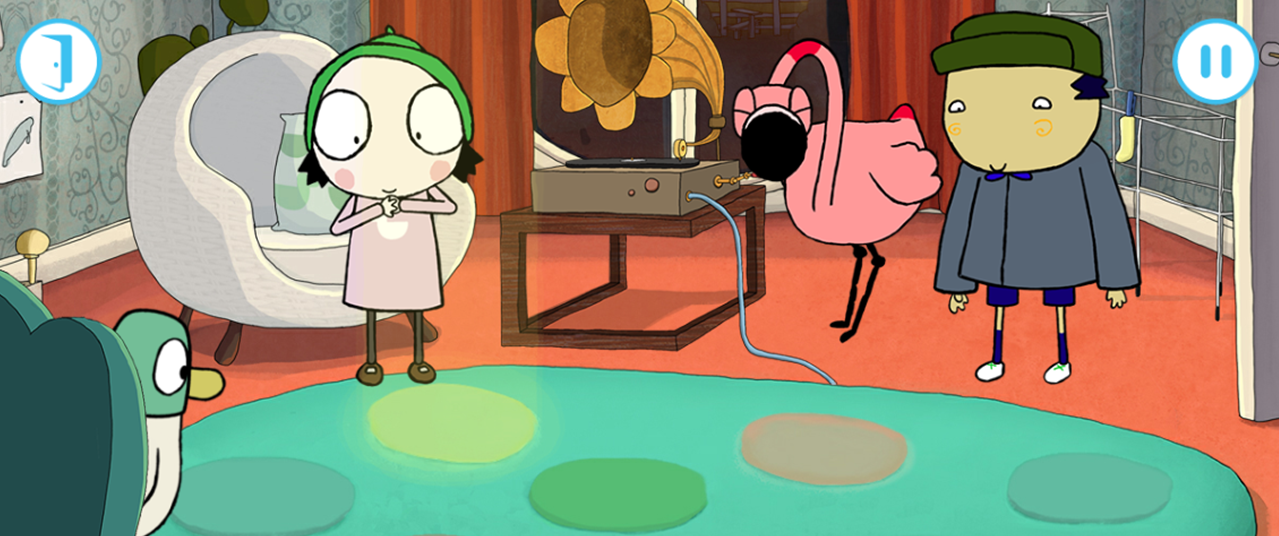
Review and Analysis of the Toddler Program Sarah & Duck
Analysis of the toddler animation Sarah & Duck produced by the BBC
Sarah is a 7-year-old little girl who wears a green hat. She is very polite and kind. Her best friend is a white duck with a green head.
Sarah, who has just learned to read, follows new adventures every day with her little friend. They talk and play with everything around them; they study whatever they like and learn interesting things as well.
The series “Sarah & Duck” Sarah & Duck was produced in three 40-episode seasons for the toddler age group. The first series was prepared in 2013, the second series in 2014, and the third series in 2015. This series was nominated for the British Academy Children’s Awards (BAFTA) in 2013 and the British Animation Award in 2014; finally, in 2014, it succeeded in winning the BAFTA Award for Best Preschool Programme.
Supplementary Information
Director : Tim O’Sullivan, Sarah Gomes Harris, Tim Fehrenbach
Writer : Sarah Gomes Harris, Benjamin Cook
Animator : Hannah de Spon, Rachel Thorn, Hozen Britto, Kaye Heywood, Alastair Park,…
Music : Tim O’Sullivan, Tanera Dawkins
Technique : 2D
Duration : 7 minutes
Country of Production : England
Year of Production : 2013
Production Company : Karrot Entertainment
Text (Theme)
| Row | Question | Answer |
| 1 | Main Meanings | Teaching the skill of proper use of recreation areas and parks – Proper use of the internet – Teaching map usage – Teaching correct choices – Park rules and regulations – Introducing different parts of a park and providing useful information about it – Being content with what one has and not casting a greedy eye on other facilities |
| 2 | Simplicity and Complexity | Expressed very simply and without complexity |
| 3 | Dependence of the Concept on the Subject and How the Work is Created | Educational concepts are explained in the form of a need for a toddler. The stages of fulfilling this need are expressed in a completely clear and explicit story. Sarah and Duck go to their park but find it closed, and for this reason, by searching the internet, they find a park that is suitable for both Sarah and Duck, locate it with a map, and realize that they have to pay money to enter and that the park has different sections with more facilities than their own park; however, when sitting on a bench, they realize its benches are not as comfortable as the park next to their house, and then they go to the park next to their house and feel very good about the softness of their own park’s bench. But when they leave the park, the adult viewer realizes that the park was closed due to painting the benches and Sarah’s clothes and Duck’s body have become colored. |
| 4 | Creation of the Work Using Character | The story has an omniscient narrator who helps Sarah and Duck, guides them, and confirms or corrects Sarah’s words. This type of narration and asking about Sarah and Duck’s feelings as well as other things helps the story’s progression, so without the omniscient narrator, the story lacks drama and action. |
| 5 | Creation of the Work Using Structure | The structure is very simple and designed in accordance with the cognitive characteristics of toddlers, like a simple drawing without details |
| 6 | Degree of Message Expression through Scenes and Sequences | Almost no scene or sequence is outside the content and message, and an equivalent image is created to express every message; however, most of the story is built upon narration, imagination, and the omniscient narrator’s dialogue with Sarah and Duck. |
| 7 | How the Message is Expressed (Preachy, Emotional, Rational) | Emotional – A pleasant feeling and dissatisfaction with something, and to convey something to the child that they should do, it places an obstacle and teaches the method of solving that obstacle. For example, the park is closed and it says let’s go to another park – it searches for a park and says so-and-so is suitable for you and not suitable for Duck and vice versa, or that it is suitable for both. Or, for example, upon entry, the guard asks for something and the narrator explains that money must be paid to enter, or when the swans in the pond make noise, it reminds Sarah that the swans seem to have their eyes on your lunch, or when the swans do not eat the food, it tells them that they didn’t seem to like it and expresses the meaning very simply so the toddler does not look for a wrong reason and get confused. For example, that they might dislike you or be afraid, and thousands of reasons that could cause them not to touch Sarah’s food. Of course, the omniscient narrator does not consider themselves omniscient and always tries to persuade Sarah with phrases like “I also think” or “I suggest” or expressions like “it’s better” or “how about this one?”. And leaves the decision to Sarah herself. |
| 8 | Speed of Theme Development | The theme is expressed very quickly and no hesitation is seen, and if the park is closed, it is immediately suggested to go to another park |
| 9 | Similarities and Differences with Programs in the Same Category | Programs of this kind usually try to advance the story with an omniscient narrator. |
| 10 | Spiritual, Moral, and Rational Provisions and Improving Human Conditions | The writer has tried to teach toddlers things in a completely creative way and build the story in a logical and rational sequence as well as moral teachings such as altruism, support, and participation. |

Character
| Row | Question | Answer |
| 1 | Plausibility of Characters | They are completely plausible and real, and the toddler audience easily accepts that Sarah is a girl their own age and the duck is also an animal, and the narrator is always with her like a mother, father, or older sister. |
| 2 | Depth and Dimension of Characters | The characters lack depth and are like a species and type, and it suffices that this is a child or this is a duck. Perhaps delving into psychological details or social dimensions would not be understandable for a toddler. But physically, the character has an extreme simplicity, depicting the generalities of a creature that actually exists, meaning a girl with large eyes and milk teeth without a nose and wearing a green hat, and a duck that has a green head. |
| 3 | Identification with Characters | Yes, the child easily identifies with the story’s characters and actually feels a closeness to the issue that is a concern for the character. |
| 4 | Plausibility of Character Action Motivation | For the toddler audience, the amount of character motivation is completely sufficient and plausible. For example, when Sarah wants to go to the park and the park is closed for some reason, the toddler audience accepts that a search should be conducted to find another park. |
| 5 | Valuation of the Hero’s Goal | Sarah’s goal in her stories is a valuable and important goal commensurate with her level of comprehension. For example, finding a new park, fixing a flat bicycle tire, buying new shoes, playing with friends, etc. |
| 6 | Degree of Understanding the Main Character’s Goal | Quickly, in the very first minute, the toddler audience in this program learns about the obstacle and the goal that can overcome the obstacle. |
| 7 | Presence of an Antagonist Preventing the Hero from Reaching the Goal | Antagonists in the about five episodes I watched are undefined individuals and always a situation as an obstacle, such as a closed park, a flat tire, torn shoes, etc. But why the antagonist is not a living character is most likely due to this subtle point that the toddler is establishing a connection with the surrounding world, and demonizing people and living creatures remains in the child’s mind and disrupts this connection-making. |
| 8 | Number of Characters | The number of characters is not very large. The hero of the story is a little girl named Sarah who has an animal assistant and a guide in the form of a voice. In each episode, usually two to three other characters are added to the work. Sarah’s umbrella, the scallions in the garden, the neighbor’s boy, another child, the moon, Flamingo, etc. |
| 9 | Over-explanation about Characters | There is no explanation about the characters, and as mentioned, the characters are only distinguished from each other by minor physical differences. |
| 10 | Degree of Character Introversion | No type of introversion is seen in any character. |
| 11 | Degree of Biographical Knowledge of the Character | No biographical information about the characters is addressed at all, meaning we never see anything about the parents and people around Sarah as the hero of the story, and other characters a fortiori. |
| 12 | Suitability of Characters to the Time and Place of the Event | The event or incident is the antagonist of Sarah & Duck’s stories, and all these incidents are designed to suit Sarah and Duck’s needs, so Sarah and Duck are always present precisely as the characters of the story. |
| 13 | How the Complexity of Human Nature and Emotions is Expressed | There is no complexity or contradiction in feelings and emotions among the characters, pointing to the subtle point that the toddler’s level of comprehension has not advanced to the point where they can tell the difference between such contradictions when facing them without becoming confused and suffering cognitive disruption. |
| 14 | Degree of Main Character Evolution and Plausibility of Its Course | Almost in these five episodes, we did not witness any evolution in Sarah’s character, and because Sarah’s character is a pure and simple archetype of a little girl, she deals with removing obstacles that have overshadowed her needs. |
| 15 | Uniformity of All Characters | One could perhaps say it is like this, meaning all the story’s characters possess a simple aspect of childhood, companionship, and everyone in their own character has transformed into a pure archetype. Meaning a shopkeeper is a shopkeeper and has no other job, or Sarah herself is a child and has no job other than playing and doing the daily chores of a little girl. |
| 16 | How Characters Relate to Each Other | The relationship between characters is completely clear, and a strong relationship flows between them. Just as Sarah is a little girl, the duck, as a playmate and pet, plays the role of a younger friend and companion for Sarah, and the narrator, as a facilitator, is guiding and creating questions in Sarah’s mind. |
| 17 | Prominence of Main and Supporting Characters | The main character, Sarah, is always prominent, and events and incidents revolve around her character, while supporting characters appear to complete the story and narrative process. |
| 18 | Neglect of Minor Roles | No, usually for every story, which is also very simple and short, minor characters are seen and the work is not wrapped up simply. |
| 19 | Suitability of Dialogues to Characters | Yes, this suitability is precisely maintained, and everyone speaks according to the extent of their role, except for the duck which doesn’t speak at all and mostly helps make the story appealing to toddlers through its comedic actions (gags). |
| 20 | Impact of Dialogue Between Characters | Usually, it is the dialogue between Sarah and the narrator that effectively advances the story and outlines subsequent goals, and the story takes shape in the process of these dialogues. |

Narration and Structure
| Row | Question | Answer |
| 1 | How the Logical Course of Narration Proceeds | The narration is entirely based on cause and effect plausible to a toddler, and the story is narrated logically; for example, when the park is closed, one must look for another park; when a bicycle tire goes flat, it must be repaired; when a shoe gets a hole, a new shoe must be bought. |
| 2 | Disjointedness of the Storyline | The story is completely connected; for example, if she is looking for a new park and goes to a new park, the story continues in the new park, or when she goes to a tire repair shop to fix a flat, the issue of the pump having low pressure arises, or when she buys new shoes, she faces the dilemma of the ticking sound of shoes on the house’s mosaic floors. |
| 3 | Number of Incidents and Their Focus on the Main Story | Usually we have two stories: a primary story that determines the initial goal, and a subsequent story that follows the adventure and is a new dilemma that must also be resolved and forms part of the first story’s subject. Example above |
| 4 | Number of Story Plots and How They Relate to Each Other | In the program Sarah & Duck, there is usually no more than one plot, and this plot is also very simple, logical, and plausible for the toddler audience. |
| 5 | Number of Subplots and Volume of the Story | The volume of the story and subplots is very small, and the entirety of each episode is between 5 and 7 minutes, and the narrative consists of two continuous stories, with no type of subplot seen in it. |
| 6 | Degree of Time Sequence or Distortion Thereof | The story is completely linear and sequential, and the first story is chronologically ahead of the second story, and no distortion is observed in the flow of the story’s time narration, which is due to the toddler’s level of comprehension of time and capacity to match it with reality. |
| 7 | Narrative Angle of the Work and Its Impact on Narration | The narration is told from the point of view of an omniscient narrator who plays a facilitating role and is very effective on the narration, because if the narration were from Sarah’s point of view, no dialogue with someone outside the frame would be heard, and the guidance and story flow would have to be narrated in another customary way. This point is very important to know that the type of narration in this work resembles storytelling for toddlers, of course a storytelling where the hero of the story is herself hearing her own story from the voice of the narrator or facilitator. |
| 8 | Degree of Complication and Engaging the Audience | Yes, the program is structured so that in the very first minute, a complication occurs in the work and the audience becomes aware of the necessity of continuing the story and sits waiting for that event to be resolved. This point itself reveals the low degree of engagement of the toddler audience with the story and demands that in toddler works, they enter the story quickly so the toddler can sit alongside and follow the story. |
| 9 | Degree of Tension Added in Subsequent Scenes and Sequences | Yes, despite there being two stories in each episode, by creating an obstacle in the story and trying to resolve it, tension suddenly rises and the obstacle-remover in the second story faces a challenge, and now we must find another remover to eliminate the obstacle from the first remover. |
| 10 | Degree of Narrative Progression in Each Scene | Yes, it can almost be said that there is no scene in the program that does not help the story’s progression, and each scene in this animation entails feedback or an introduction for the audience. |
| 11 | Possibility of Deleting a Scene or Sequence | It can be said that the director of the work has designed the scenes with utmost parsimony, let alone sequences, and this does not allow for the deletion of scenes from this animation, as part of the message would not be conveyed to the audience or a disruption would occur. |
| 12 | Amount of Screenplay Raw Material | There is no complexity or contradiction in feelings and emotions among the characters, pointing to the subtle point that the toddler’s level of comprehension has not advanced to the point where they can tell the difference between such contradictions when facing them without becoming confused and suffering cognitive disruption. |
| 13 | Impact of High Points, Low Points, Turning Points, Climax, and Ending Points | All these points are seen in each episode like a very simple classical work, and each is embedded simply to the understanding of a toddler from the story. |
| 14 | Correct Placement of the Climax in the Story | Yes, in each of the two stories of every episode, the climax is located near the end point. For example, in the park story, the first climax is finding the third park on the map, at the end of which the map is printed and they move toward the park. |
| 15 | Appeal, Suitability, Impact, and Plausibility of the Story’s Ending | For a toddler, it could perhaps be said that if there were an appeal beyond looking for a good park on a computer system, it might be a bit exaggerated and implausible, and it is suitable for the toddler’s spirit and level of comprehension. But whether other endings can be imagined and other appeals added to it, one might say yes, it is possible. However, because it is very difficult to figure out the extent of its impact on a toddler’s spirit, it requires serious research and experience. |
| 16 | Suitability of Rhythm and Tempo in the Screenplay | The rhythm is very fast and the work’s tempo is also playing uniformly. |
| 17 | Prevalence of Fictitious and False Information | In this work, information is given commensurate with the toddler’s knowledge, and even family introductions do not take place; but for example, using a computer in the park episode, the method of visiting the tire repair shop in the pump episode, the method of visiting a shoe store, and distinguishing between shoe stores are information that is novel for the toddler, and all this information is also displayed in the simplest and most understandable way possible, meaning they become familiar with the totality of a shop, the totality of a computer, and searching the internet. |
| 18 | Common Mistakes in Prediction | Surprise is one of the appeal principles in this program, and even an adult cannot guess correctly, and endings are never spoiled, and the story proceeds with this appeal without creating dread and anxiety. |
| 19 | Common Mistakes in Creating Dread | Almost no feeling of dread and anxiety related to lack of information, false dread, inequality of obstacle and remover, etc. is seen, and they have paid very good attention to this subtle point about not tarnishing the toddler’s emotions. |
| 20 | Pattern of Organizing the Story and Narration | This program is built upon generating creative thinking and creating questions and searching for solutions. Therefore, the story of this work continues by creating an obstacle and creating a thinking-like situation to find and choose the appropriate solution. |

Image Composition
| Row | Question | Answer |
| General | This program has 4 sequences, with each sequence ending with a fade to a black screen. There are 71 shots counting the three black images. There is 1 tilt, 2 zoom-outs, and 3 pans in this program. The camera angle in most shots is eye-level. And in 3 shots, it introduces high-angle camera positions and overlooks the subjects. |
|
| 1 | How Image Composition and Creative Shots are Used |  Patterns and Textures  Golden Point and Color  Golden Point  Golden Point and Color Combination 
Rule of Thirds
Leading Lines and Symmetry
Central Composition, Symmetry, and Rule of Odds
Central Composition and Symmetry
Frame within a Frame and Balance
Balance and Rule of Odds |
| 2 | Filmmaker’s Awareness of the Focal Point of Images | Yes, in most images, the subject is located at the golden point. |
| 3 | Filmmaker’s Use of Focal Point Creation Methods | In field one, some images indicate that attention has been paid to this matter using various techniques. |
| 4 | Filmmaker’s Use of Horizontal, Diagonal, Curved, and Vertical Lines to Intensify and Strengthen Dramatic States | |
| 5 | Filmmaker’s Use of Depth Composition for Dimensionality in Dramatic Emotions | Movement of Duck and Sarah into depth |
| 6 | Degree of Filmmaker’s Use of Various Image Compositions |    |
| 7 | Filmmaker’s Attention to Dynamic Composition in Moving Images | In these two scenes, an attempt is made to create dynamism in the images through zoom-out movement |
| 8 | Filmmaker’s Attention to Conveying Meaning by Changing Shot Size and Angle | The shot changes from a long shot to a medium shot to show the park is closed. It changes from a long shot to a shot and from a shot to a close-up to make the confrontation serious.
The shot changes from a shot to a close-up to emphasize that the bench is painted. |
| 9 | Filmmaker’s Attention to Conveying Meaning Using Various Lenses | Almost no dimensionality with lenses or lighting is used in this animation. |


Download the PDF file of the Sarah & Duck program analysis
Review and Analysis of the Sarah & Duck Program